

Published October 20, 2022 · Updated June 16, 2026 · By Chris Nevada, Nevada Real Estate Group · NV License S.181401
Moving to a new city — whether it is across the state or across the country — is one of the most consequential decisions most families make in a decade. In my 16-plus years as a Las Vegas real estate agent and owner of Nevada Real Estate Group, I have guided more than 9,600 clients through relocations of every kind: cross-country corporate moves, retirement migrations, fresh-start reinventions, and everything in between. The patterns are consistent: the people who succeed are the ones who do serious research, build realistic budgets, and connect with a local agent before they ever sign a lease or purchase contract.
This guide is designed to be that research. Whether you are still deciding where to go or already have a zip code picked out, these pages walk you through every step — from building your relocation budget to registering your kids for school in week one. I use Las Vegas as the primary example throughout, because it is genuinely one of the most compelling relocation markets in the country right now. But the framework applies wherever you land.
Successfully moving to a new city requires a written budget ($8,000 to $25,000 for a cross-country household move), a neighborhood shortlist built 60-plus days before signing, and a local agent who knows which streets are appreciating. Las Vegas is the showcase: $430,000 median home price, zero state income tax, and three years running as the most-searched U.S. relocation destination from the West Coast. Start with your agent, then your neighborhood, then your movers.
- Budget $8,000 to $25,000 total for a cross-country household move in 2026, including movers, security deposits, and first-month overlap costs.
- Las Vegas median home price is approximately $430,000 — with no state income tax, saving a family earning $120,000 roughly $6,000 to $9,000 annually vs. California.
- Start your neighborhood research at least 60 days before signing anything; an Airbnb test-stay in your top two neighborhoods is the single best $300 to $700 you will spend.
- Henderson, Summerlin, and North Las Vegas each offer distinct lifestyle profiles — Henderson for safety rankings, Summerlin for master-plan amenities, North Las Vegas for entry-level value under $350,000.
- Call (702) 637-1759 to speak with a Nevada Real Estate Group agent who specializes in Las Vegas relocations — we have helped hundreds of out-of-state families navigate this exact process.

How Do You Plan a Move to a New City?
Every successful move starts with a decision framework. Before you book a moving truck or pull up the Las Vegas MLS — you need to answer three foundational questions: Why this city? What is my budget ceiling? And what lifestyle non-negotiables must the new city satisfy?
For people moving because of a job offer or transfer, the first question is answered for you. For everyone else — retirees chasing warmth and low taxes, remote workers craving space, or families looking for affordable homeownership — the decision deserves serious analysis. According to the U.S. Census Bureau, Nevada was one of the top three fastest-growing states by net domestic in-migration from 2020 through 2024, driven almost entirely by California, Washington, Oregon, and Illinois out-migration. The reasons are consistent: cost of living, tax relief, and housing affordability.
Once you have settled on a city, build your research in three layers:
- City-level research: crime trends, employment base, school district ratings, climate, and commute infrastructure
- Neighborhood-level research: walkability scores, median price per square foot, HOA rules, flood zones, proximity to your workplace
- Property-level research: inspection history, days on market, price reductions, neighborhood turnover rate
That third layer is where a local real estate agent becomes indispensable. I can pull six months of closed sales on a single street in Henderson or Summerlin in under five minutes — that data is simply not available on consumer portals. Across the 9,600-plus closings Nevada Real Estate Group has represented, clients who did all three layers of research before committing to a neighborhood report significantly higher satisfaction at the 12-month mark.
How Do You Budget for a Relocation?
Moving costs shock people more than almost any other life expense. The internet is full of $2,000 estimates that apply only to a studio apartment moving 50 miles. A cross-country move for a three-bedroom household in 2026 typically runs $5,000 to $18,000 for the move itself — and that is before the real expenses hit.
| Budget Category | Low Estimate | Mid Estimate | High Estimate |
|---|---|---|---|
| Professional movers (cross-country, 3BR) | $5,000 | $9,500 | $18,000 |
| Packing materials & supplies | $100 | $300 | $600 |
| Temporary housing (overlap weeks) | $0 | $1,200 | $4,500 |
| Storage unit (1-3 months) | $0 | $450 | $1,500 |
| Travel costs (flights / gas / hotel) | $200 | $800 | $2,500 |
| New utility deposits & setup fees | $200 | $500 | $1,200 |
| First 30-day incidentals (IKEA run, etc.) | $300 | $1,500 | $4,000 |
| Home purchase closing costs (if buying) | $6,000 | $11,000 | $18,000 |
| TOTAL (buying scenario) | $12,000 | $25,250 | $50,300 |
According to the Consumer Financial Protection Bureau, homebuyers should budget 2% to 5% of the purchase price in closing costs. On a $430,000 Las Vegas median-priced home, that is $8,600 to $21,500. If you are using a conventional loan at 10% down, add $43,000 in down payment. Total cash-to-close on a typical Las Vegas purchase: $51,600 to $64,500.
The good news: Nevada has no state income tax. A family moving from California earning $150,000 annually saves approximately $8,000 to $11,000 per year in state income taxes alone. Over a five-year horizon, that savings more than covers the entire cost of the move.
What Is a Realistic Moving Timeline?
One of the most consistent mistakes I see in my 16-plus years: people underestimate how long preparation takes. Most families need 90 to 120 days from "decision made" to "settled in new home." Here is a realistic framework.
| Timeframe | Key Actions | Estimated Cost |
|---|---|---|
| 90 days out | Finalize destination city; hire local agent; start neighborhood research; get pre-approved for mortgage | $0 to $300 |
| 75 days out | Book test-stay in top neighborhoods (Airbnb); narrow to 3 target communities; give notice at current job if needed | $300 to $700 |
| 60 days out | Get 3 moving company quotes; begin sorting and donating; notify current landlord or list home for sale | $0 |
| 45 days out | Book movers; begin home search with agent; set up mail forwarding with USPS; notify subscriptions | $200 to $500 |
| 30 days out | Begin packing non-essentials; transfer medical records; contact new school district | $100 to $300 |
| 2 weeks out | Pack all but daily essentials; confirm moving date; schedule utility start dates at new address | $200 to $400 |
| Move week | Final walkthrough; pack overnight bag; tip movers; pick up keys or close on home | $100 to $300 |
| Days 1-30 post-move | Update driver's license; register to vote; enroll kids in school; set up utilities; explore neighborhoods | $50 to $200 |
According to USPS Moving Central, setting up mail forwarding at least two weeks before your move date prevents the most common post-move headaches — missed bank statements, missed medical bills, and missed government notices.
How Do You Choose the Right Neighborhood?
Choosing a neighborhood is not a one-size-fits-all decision. A 28-year-old remote worker has entirely different priorities than a family with three school-age kids or a retiring couple looking for a 55-plus community. Here is how I coach clients through the neighborhood decision:
Step 1: List your non-negotiables. Commute time (if you have one), school district rating, walkability, HOA or no HOA, price range, and crime. Write them down in order of importance.
Step 2: Research remotely. According to GreatSchools, school quality ratings vary significantly even within the same city. In Las Vegas, a move from one zip code to an adjacent one can shift your kids from a 4/10 school to an 8/10 school. Use GreatSchools, CCSD's school boundary tool, and the Clark County Assessor's parcel search to narrow your list.
Step 3: Do a test-stay. Book an Airbnb or extended-stay hotel in your top two neighborhoods for 3 to 5 nights. While there, search active listings to calibrate prices in real-time. Drive the commute at rush hour. Walk to the grocery store. Have dinner at the local restaurant. Visit the neighborhood park on a Saturday morning. You will learn more in 96 hours than in 96 hours of online research.
Step 4: Ask your agent for closed-sales data. I pull this for every client — how many homes sold in the last six months, average days on market, price per square foot trend, and what percentage of sellers got at or above asking price. Rising days on market and falling price-per-square-foot are early warning signs of a softening micro-market.
How Do You Research a New City's Cost of Living?
Cost of living is more than rent or mortgage. It is the full basket: housing, taxes, utilities, groceries, transportation, healthcare, and childcare. According to the Bureau of Labor Statistics, the average American household spends approximately $72,000 annually across these categories. In Las Vegas, that number runs about 8% to 12% below the national average — and about 30% to 40% below the Los Angeles or San Francisco metro areas.
For a practical look at the cost of living in Las Vegas, consider:
- Housing: Median home price approximately $430,000; median rent for a 2BR approximately $1,600 to $1,900/month
- Taxes: Zero state income tax; property tax effective rate approximately 0.53% (one of the lowest in the nation); no capital gains tax at the state level
- Utilities: Nevada Power (NV Energy) average monthly bill approximately $110 to $140 for a typical 1,800 sq ft home
- Groceries: Roughly 2% to 5% below the national average index
- Healthcare: Slightly above national average, per HUD's Comprehensive Housing Market Analyses
If you are coming from California, the tax savings alone are transformative. A household earning $120,000 in California pays approximately $6,300 to $8,500 in state income tax annually. In Nevada: $0. That is an extra $525 to $708 per month that stays in your pocket.
How Do You Handle Logistics and Movers?
Hiring a mover is one of the highest-risk, highest-variable costs in any relocation. The moving industry has a notorious history of lowball estimates followed by "hostage truck" situations where final bills arrive 40% to 80% above the original quote. Here is how to protect yourself:
- Get 3 to 4 binding estimates, not non-binding. A binding estimate means the price is locked; a non-binding estimate is just a guess.
- Check FMCSA registration. According to the Federal Motor Carrier Safety Administration (FMCSA), every interstate mover must be registered and carry a USDOT number. Verify it before signing anything.
- Declutter before they quote. Every item that goes on the truck adds to weight and cost. A ruthless purge before the quote locks in a lower baseline.
- Pack non-essentials yourself. Professional packing adds $500 to $3,000 depending on volume. Packing your own books, art, and clothing saves substantially.
- Buy separate moving insurance. Standard carrier liability covers approximately $0.60 per pound per item — barely enough to replace a laptop if it gets broken. Third-party moving insurance runs $100 to $400 but covers actual replacement value.
For Las Vegas arrivals specifically, I recommend scheduling move-in for late fall through early spring if possible. Summer temperatures averaging $105 to $115 degrees Fahrenheit make moving exhausting and can cause heat damage to electronics and furniture.

What Should You Do in Your First 30 Days?
The first 30 days after a move are the busiest administrative period most people experience outside of starting a business. Here is a prioritized checklist for your first month in a new city:
Days 1 to 7 — Immediate necessities:
- Confirm all utilities are active (electric, water, gas, internet)
- Locate the nearest urgent care clinic and emergency room
- Find your nearest grocery store, pharmacy, and hardware store
- Change the locks on your new home (recommended regardless of circumstances)
Days 8 to 14 — Administrative:
- Update your mailing address with the USPS
- Notify your bank, credit cards, insurance companies, and investment accounts
- Update your voter registration with the Nevada Secretary of State
- Register your vehicle with the Nevada DMV (required within 30 days for new residents)
Days 15 to 21 — Community integration:
- Visit the Clark County School District office or your assigned school to enroll children
- Register pets with Clark County Animal Control (required for dogs and cats)
- Locate your nearest USPS post office and library branch
- Introduce yourself to immediate neighbors
Days 22 to 30 — Financial and tax setup:
- Update your withholding information with your employer (no more state income tax withholding)
- Notify the IRS of your new address via Form 8822
- Apply for Nevada driver's license (required within 60 days of establishing residency)
- Set up automatic bill pay for local utilities
Why Are So Many People Moving to Las Vegas in 2026?
According to the U.S. Census Bureau, Clark County, Nevada added more than 40,000 new residents per year from 2020 through 2024, making it one of the fastest-growing counties in the country. If you are actively considering moving to Las Vegas, the reasons are quantifiable:
No state income tax. Nevada is one of only nine states with no state income tax. For a family earning $100,000, that is $3,000 to $7,000 in annual tax savings compared to California, Oregon, or Washington. Over a 10-year homeownership period, that is $30,000 to $70,000 in cumulative savings — a significant portion of a down payment.
Affordable housing relative to coastal cities. The Las Vegas median home price sits around $430,000 in mid-2026 — roughly half the median in Los Angeles ($890,000) and less than a third of the San Francisco Bay Area ($1.4 million). A $430,000 Las Vegas home buys 2,200 to 2,600 square feet with a yard, a two-car garage, and often HOA amenities like a pool and fitness center.
Low property taxes. According to the Nevada Department of Taxation, Nevada's effective property tax rate is approximately 0.53% — among the lowest in the country. On a $430,000 home, that is approximately $2,279 per year, or about $190 per month.
Job market diversification. Las Vegas has spent the last decade deliberately diversifying beyond hospitality. The tech sector, healthcare (Valley Health System, Sunrise Health), logistics (Amazon, FedEx major distribution hubs), and professional services have all expanded significantly. According to the Bureau of Labor Statistics, the Las Vegas metro unemployment rate as of early 2026 sits near 4.8%, down from pandemic peaks above 30%.
Year-round lifestyle. Three hundred days of sunshine annually. Proximity to Red Rock Canyon National Conservation Area (15 minutes from most zip codes), Lake Mead National Recreation Area (30 minutes), Mount Charleston (45 minutes), and the Colorado River corridor (90 minutes). Golf, hiking, mountain biking, and water sports are all within range of a Saturday.

How Does a Local Agent Make Relocation Easier?
A local real estate agent does not just find you a house. In a relocation context, a good agent functions as a city orientation expert, a market analyst, and a logistics coordinator — all rolled into one professional relationship.
Across the 9,600-plus closings Nevada Real Estate Group has handled — totaling more than $4.85 billion in volume — roughly 35% to 40% of our buyers arrive from out of state. I've represented families relocating from California, Arizona, Utah, Illinois, New York, Texas, and a dozen other states. In our experience, clients who engage a local agent 60 to 90 days before their target move date consistently close on better properties, at better prices, with fewer surprises, than clients who call two weeks before they need to be in.
Here is specifically what our team provides to relocation clients:
- Pre-move neighborhood briefings: a 30-minute video call covering the top three neighborhoods for your budget and lifestyle criteria, with recent closed-sale data and price-per-square-foot trends
- Virtual tours: we tour properties on your behalf and record walkthroughs if you cannot fly out immediately
- Contractor network: pre-vetted inspectors, lenders, title companies, and handymen who know the Las Vegas market
- School and community research: we maintain current GreatSchools ratings, CCSD enrollment data, and HOA financial health reports for every major community we work in
- Negotiation expertise: in a market where new construction builders include negotiable closing cost credits and rate buydowns, knowing what is negotiable and what is not is worth tens of thousands of dollars
Call (702) 637-1759 or contact our office at 8945 W Russell Rd Suite 170, Las Vegas NV 89148 to schedule your complimentary relocation consultation.
What Are the Tax Benefits of Moving to Nevada?
Tax savings are not abstract for most Las Vegas relocators — they are the primary financial reason to make the move. Here is a complete breakdown of Nevada's tax advantage:
State income tax: $0. Nevada has no personal income tax, period. No brackets, no withholding, no annual filing. According to Nevada's Department of Taxation, this applies to wages, self-employment income, capital gains, rental income, and retirement distributions. For a dual-income household earning $200,000 combined, the annual savings versus California (13.3% top marginal rate) can exceed $15,000 per year.
Capital gains tax at state level: $0. When you sell your Las Vegas home, the state of Nevada takes nothing from your profit. The federal exclusion ($250,000 for single filers, $500,000 for married couples) still applies, but there is no Nevada overlay.
| Tax Category | Nevada | California | National Average |
|---|---|---|---|
| State income tax (top rate) | $0 / 0% | Up to 13.3% | approx. 5% |
| Annual savings (family at $120K income) | $0 tax | $6,300 to $8,500 paid | $3,000 to $5,000 paid |
| Capital gains tax (state level) | $0 | Up to 13.3% (ordinary income rate) | Varies (0 to 13%) |
| Property tax effective rate | approx. 0.53% | approx. 0.73% (Prop 13 capped) | approx. 1.07% |
| Annual property tax on $430K home | approximately $2,280 | approximately $3,140 | approximately $4,600 |
| Social Security / pension state tax | None | None (CA exempts SS) | Varies by state |
| Estate / inheritance tax | None | None | Varies by state |
Social Security and pension income: not taxed. According to the Social Security Administration, Nevada does not tax Social Security benefits or pension income at the state level — a significant advantage for retirees relocating from high-tax states.
Property taxes: approximately 0.53% effective rate. According to the Nevada Department of Taxation, the statutory property tax rate is capped at $3.64 per $100 of assessed value, and assessed value is set at 35% of taxable value — meaning the effective rate on market value is typically 0.50% to 0.60%. On a $430,000 home: approximately $2,150 to $2,580 per year.
Estate/inheritance tax: $0. Nevada has no estate tax or inheritance tax, making it an attractive option for estate planning.
The combined state and local tax burden in Nevada — income, property, and sales — consistently ranks among the five lowest in the country, per annual analyses by the Tax Foundation.
How Do You Transfer Schools, Licenses, and Records?
Administrative transfers are the most tedious part of any relocation. Here is a practical checklist for the major categories:
Schools: Contact the Clark County School District (CCSD) enrollment office. You will need proof of address (lease or deed), immunization records, and previous school records. CCSD accepts transfer credits from all 50 states and most international programs. Enrollment can be completed online at the CCSD parent portal. According to CCSD, Clark County operates over 350 schools serving more than 300,000 students — the fifth-largest school district in the United States.
Driver's license: Nevada requires new residents to obtain a Nevada driver's license within 60 days of establishing residency. You will need your current out-of-state license, proof of Nevada residency (two documents), Social Security number, and the applicable fee ($42.25 as of 2026). Nevada DMV offices are in Henderson, North Las Vegas, Las Vegas west, Las Vegas east, and Summerlin.
Vehicle registration: Nevada requires vehicle registration within 30 days of establishing residency. You will need a Nevada emissions test (VIN inspection for out-of-state vehicles), proof of Nevada insurance, and payment of registration fees (typically $65 to $450 depending on vehicle age and value).
Medical records: Contact your current providers and request complete records in writing. HIPAA requires providers to release your records within 30 days of a written request, typically at a fee of $0.50 to $1.00 per page. Most major Las Vegas health systems — Valley Health System, Sunrise Health, UMC — can receive digital record transfers.
Professional licenses: Nevada has reciprocity agreements with most states for licensed professionals including real estate, nursing, teaching, engineering, and law. The Nevada Secretary of State website maintains the current reciprocity table. According to the Nevada Secretary of State, most professional license transfers take 30 to 60 days.
Voter registration: Nevada allows same-day voter registration. You can register at any DMV office, online, or at your polling place on election day.
What Do First-Time Relocators Most Often Overlook?
After 16-plus years of guiding relocations, I have a clear picture of what surprises people most — and it is rarely the things they worried about.
Summer heat. Las Vegas summers average 105 to 115 degrees Fahrenheit. Outdoors activities shift dramatically: morning workouts, evening walks, and weekend trips to higher elevations are the pattern. Utility bills spike in July and August — budget $200 to $350 per month for cooling. The tradeoff: 300-plus sunny days annually and winters averaging 50 to 60 degrees.
Water and landscaping costs. Las Vegas sits in the Mojave Desert. The Southern Nevada Water Authority enforces strict watering schedules, and traditional grass lawns are actively being phased out through rebate programs. New residents often underestimate the cost of converting landscaping to desert-adapted plants (approximately $1,000 to $5,000 for a typical lot).
HOA culture. A large percentage of Las Vegas homes — particularly in master-planned communities like Summerlin, Anthem, and Providence — carry HOA fees ranging from $30 to $400 per month. HOA rules govern paint colors, landscaping, parking, and architectural modifications. Read the CC&Rs carefully before signing.
Car dependency. Las Vegas is not a walking city except in a handful of neighborhoods. A reliable vehicle is non-negotiable for most households. Budget for higher-than-average auto insurance rates — Nevada ranked 14th nationally in average auto insurance costs in 2025, per the National Association of REALTORS.
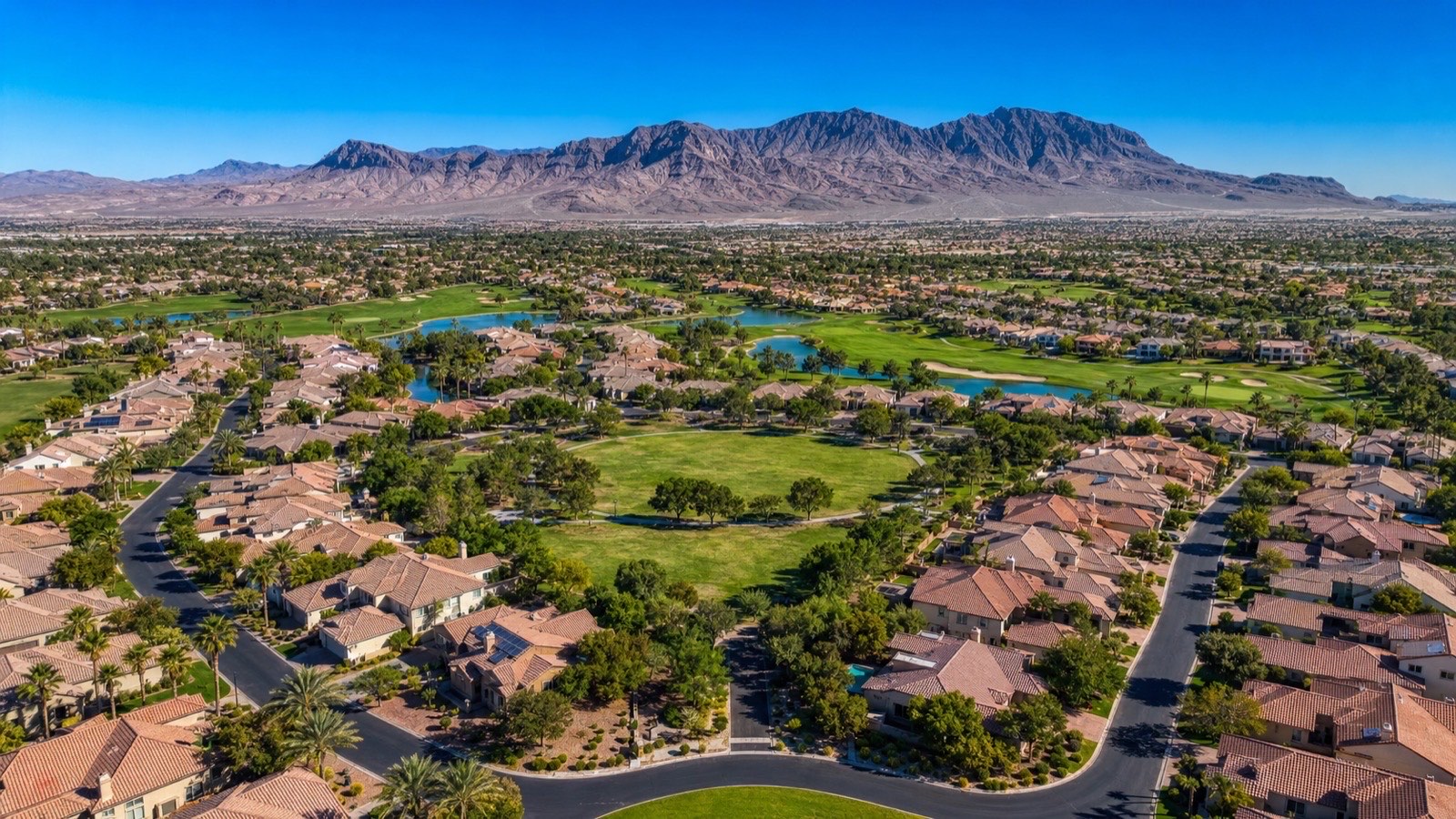
The Strip is not your neighborhood. Las Vegas residents almost never visit the Strip except for major events or out-of-town guests. The residential areas of Henderson, Summerlin, and North Las Vegas operate as entirely separate communities from the tourism corridor. This surprises many new arrivals who expected to feel like they were living in a casino — and pleasantly surprises the ones who were worried about that.
To explore the best neighborhoods for your lifestyle and budget, our team has put together detailed breakdowns of every major Las Vegas community.
Frequently Asked Questions About Moving to a New City
How much money should I save before moving to a new city?
Financial advisors generally recommend having three to six months of living expenses in liquid savings before a major relocation — enough to cover your move costs, first and last month's rent or down payment, and a cushion for unexpected expenses. For a Las Vegas relocation targeting a $430,000 home with 10% down, plan to have at least $55,000 to $70,000 in liquid savings. Renters targeting a $1,800/month apartment should have $8,000 to $12,000 available.
Is it better to rent first or buy when moving to a new city?
In most cases, renting for six to twelve months before buying gives you time to learn the city's neighborhoods from the inside out. The exception: if you have done exhaustive research, worked with a local agent, and have a strong sense of the specific community you want, buying sooner avoids rental prices (Las Vegas 2BR median is approximately $1,750/month) and locks in your price before further appreciation. According to Las Vegas REALTORS (LVR), Las Vegas home prices have appreciated an average of 7% to 9% annually over the last five years — waiting 12 months to buy could mean paying $30,000 to $40,000 more for the same property.
What is the cheapest neighborhood in Las Vegas for a first-time buyer?
North Las Vegas consistently offers the most affordable entry points in the Las Vegas Valley. The Aliante community — a 1,900-acre master plan on the north side — features homes priced from approximately $290,000 to $380,000 with parks, trails, and a nature discovery center. Portions of enterprise and Spring Valley in the southwest corridor also offer homes under $350,000. For a detailed look, our North Las Vegas community guide covers price ranges and lifestyle profiles for every major area.
How long does it take to get a Nevada driver's license after moving?
Nevada requires new residents to obtain a Nevada driver's license within 60 days of establishing residency. In practice, most DMV appointments can be scheduled within one to three weeks. Bring your out-of-state license, two proof-of-residency documents (utility bill, bank statement, lease), your Social Security card or number, and $42.25. Nevada has six DMV locations in the Las Vegas Valley.
Do I need a real estate agent to buy a home in Las Vegas?
You are not legally required to use an agent, but in a market with over 10,000 active listings and significant builder-negotiation complexity, representation is strongly advisable. In Nevada, since August 2024, buyer's agent compensation is negotiated upfront in a written buyer-broker agreement. Nevada Real Estate Group offers buyers a complimentary relocation consultation — call (702) 637-1759 to start the conversation.
What is the cost of living in Las Vegas compared to California?
According to the Bureau of Labor Statistics, the Las Vegas metro cost of living index runs approximately 10% to 15% below Los Angeles and approximately 35% to 45% below the San Francisco Bay Area. The largest driver is housing: a median $430,000 Las Vegas home compares to roughly $890,000 in Los Angeles for similar square footage. Add in zero state income tax, and the combined financial advantage for a $120,000 household income is approximately $18,000 to $25,000 per year.
What should I look for in a Las Vegas neighborhood?
The four factors that correlate most strongly with long-term satisfaction among our relocation clients: school district performance (CCSD ratings vary significantly by neighborhood), commute time to your workplace, HOA financial health (underfunded HOAs create deferred maintenance and special assessments), and micro-market price trends (rising days on market and shrinking price-per-square-foot growth are warning signs). Your NREG agent can provide a neighborhood data brief for any community you are considering — call (702) 637-1759.
Which Sources Inform This Relocation Guide?
- U.S. Census Bureau — State and County QuickFacts — population and migration data
- Bureau of Labor Statistics — Employment and Unemployment — Las Vegas metro employment trends
- USPS Moving Central — Address Change and Mail Forwarding — official mail forwarding guidance
- IRS — Change of Address (Form 8822) — federal address update procedures
- HUD — Comprehensive Housing Market Analyses — regional housing affordability benchmarks
- Nevada Department of Taxation — Property Tax FAQ — Nevada property tax rates and exemptions
- Las Vegas REALTORS (LVR/GLVAR) — Market Statistics — Clark County median sales price and volume data
- Consumer Financial Protection Bureau — Buying a Home — closing cost guidance and mortgage disclosures
- Social Security Administration — Nevada Tax Overview — state taxation of Social Security and pension income
- National Association of REALTORS — State Economic Data — cost of living comparisons and auto insurance rankings
- Clark County School District — Enrollment Information — CCSD enrollment procedures and school boundary maps
- Federal Motor Carrier Safety Administration — Mover Registration — interstate mover verification tool