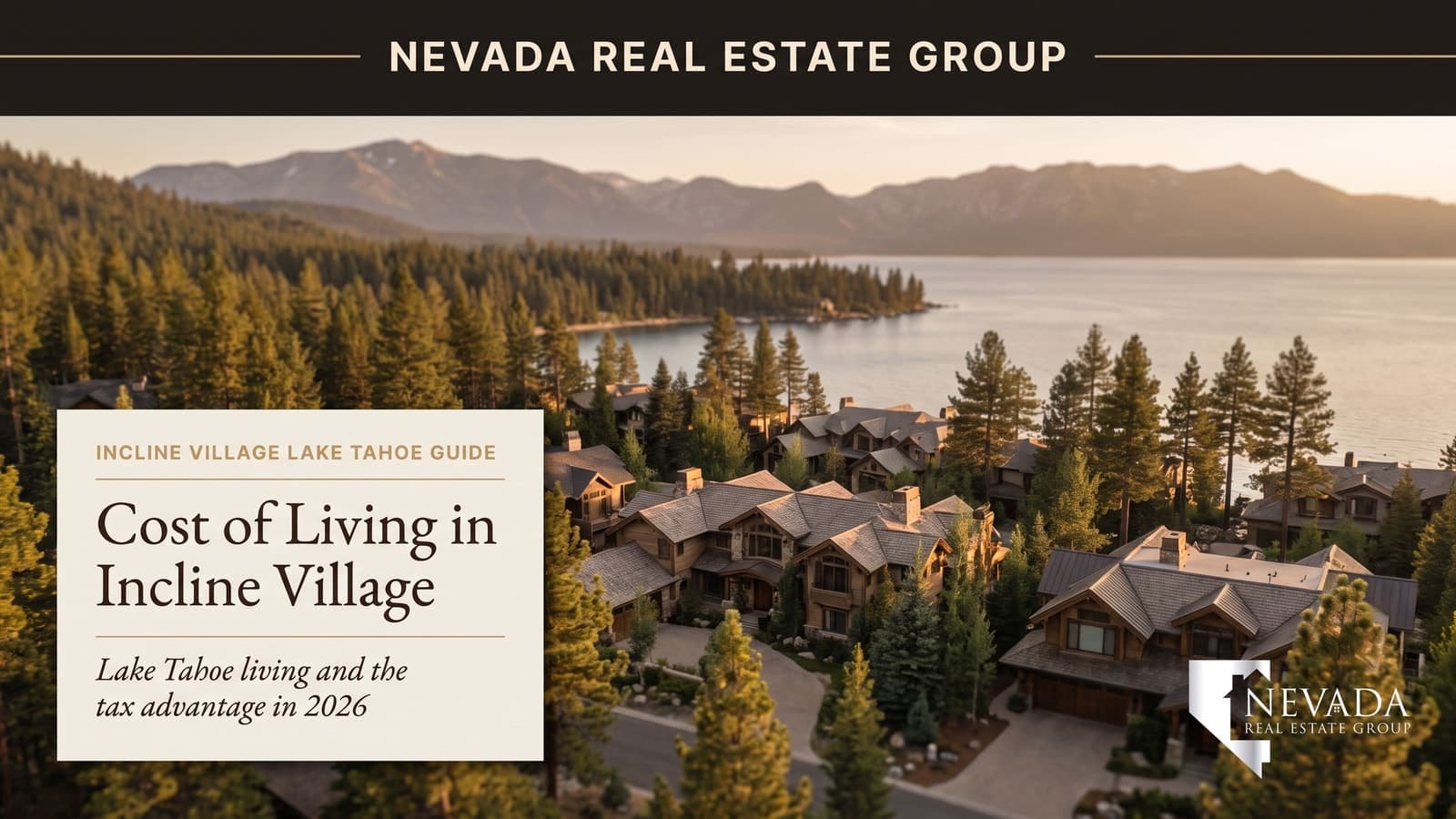

Published July 1, 2026 · By Chris Nevada, Nevada Real Estate Group · NV License S.181401
The cost of living in Incline Village, NV in 2026 is unlike anywhere else in the state: it is expensive by any measure, yet for the right buyer it can be one of the smartest financial moves in the country. Incline Village sits on the Nevada shore of Lake Tahoe, where the median single-family home runs about $1.5 million and lakefront estates reach the tens of millions. But the draw is not affordability — it is the combination of one of the world's great alpine settings with Nevada's zero state income tax, which turns Incline into a genuine tax haven for high earners fleeing California.
I work with buyers on both ends of this spectrum — retirees right-sizing into a Tahoe condo and executives establishing Nevada residency to protect seven-figure incomes. Across the more than 9,600 transactions Nevada Real Estate Group has closed, Incline Village is where the tax math matters most, because the income-tax savings for a high earner can exceed a lifetime of housing premiums. This guide breaks down the real cost of living in Incline Village — housing, utilities, daily life — then explains the tax advantage that defines the market and who actually lives here. For a personalized look, call our Northern Nevada team at (775) 277-2120 or browse Incline Village homes for sale.
The cost of living in Incline Village, NV in 2026 is high, driven almost entirely by housing — the median single-family home runs about $1.5 million, condos start near $600,000, and lakefront estates reach tens of millions. Daily costs run above average in the alpine setting. But Nevada's zero state income tax makes Incline a tax haven: for a high earner, the annual income-tax savings versus California can reach six figures, often outweighing the housing premium.
- Incline Village's median single-family home runs about $1.5 million; condos start near $600,000.
- Daily costs run above average given the alpine, resort location on Lake Tahoe's Nevada shore.
- Nevada's zero state income tax is the defining draw — a tax haven for high earners leaving California.
- For a seven-figure earner, annual income-tax savings can exceed $100,000, outweighing housing costs.
- Buyers range from retirees in condos to executives establishing Nevada residency — call (775) 277-2120.
How much does it cost to live in Incline Village?
Living in Incline Village in 2026 is expensive, and there is no getting around it — this is one of the priciest markets in Nevada. The cost is driven almost entirely by housing, where the median single-family home runs about $1.5 million and even entry-level condos start near $600,000. Beyond housing, the alpine, resort location means groceries, dining, services, and fuel all run above the national and even the Reno-area average, simply because everything is trucked up the mountain and the market skews affluent.
But framing Incline purely on cost misses the point. For the high earners who make up much of the market, the relevant math is not the grocery bill — it is the state income tax they no longer pay. According to the Tax Foundation, Nevada's overall tax burden ranks among the lowest in the country, and for someone leaving California's top rates, the savings can be enormous. In my experience, the buyers happiest in Incline are the ones who ran that full calculation — the housing premium against the tax savings and the Lake Tahoe lifestyle — and found it more than worthwhile. Our companion guide on the cost to live on Lake Tahoe covers the broader basin. The sections below break Incline's costs down.
How much does housing cost in Incline Village?
Housing is the dominant cost in Incline Village by a wide margin. The median single-family home runs about $1.5 million, with the range spanning from condos near $600,000 to custom homes at $3 million to $8 million and lakefront estates that reach $10 million to $30 million and beyond. Even a modest Incline home commands a price that reflects its location on one of the most sought-after shorelines in the world.
| Home type | Approx. price range | Notes |
|---|---|---|
| Condo / townhome | $600,000–$1,200,000 | Entry point to Incline |
| Single-family (non-lakefront) | $1,200,000–$3,000,000 | Median near $1.5 million |
| Custom / view home | $3,000,000–$8,000,000 | Larger lots, lake views |
| Lakefront estate | $10,000,000–$30,000,000+ | Trophy properties |
According to Northern Nevada market data, Incline Village home values have held strong because the supply is fixed — the community is essentially built out, ringed by national forest, so there is little room for new construction. That scarcity, combined with the tax appeal and the Tahoe lifestyle, keeps values durable, and it means Incline behaves differently from a normal housing market: prices are driven less by local wages and more by the wealth and tax motivations of buyers who can live anywhere and choose the Nevada shore of Lake Tahoe. For buyers financing a purchase, the monthly cost scales accordingly, but a large share of Incline transactions are cash or large-down-payment deals, particularly among the high earners and second-home owners who dominate the market. The nearby Lake Tahoe communities and the Crystal Bay area offer related options along the Nevada shore.
What do utilities and daily costs run in Incline Village?
Utilities and daily costs in Incline Village run above average, reflecting the mountain location and the four-season alpine climate. Heating is the significant utility cost — Incline sits at over 6,200 feet, so winters are real and long, and a large home can run $300 to $600-plus a month to heat in the cold months. Water, sewer, and trash are handled largely through the Incline Village General Improvement District, which also funds the community's recreation amenities. Internet and the usual services add the standard monthly costs, with connectivity generally solid.
Groceries, dining, and services all carry a premium in Incline. A household of four can easily spend $1,200 to $1,800 a month on groceries and household goods, above the national average, because the market is small, affluent, and remote. Dining out is resort-priced. According to the Bureau of Labor Statistics, mountain resort communities consistently run above national norms on daily costs for exactly these reasons. None of this is the deciding factor for most Incline buyers, though — for the market's typical buyer, the daily premium is a rounding error against the home price and the income-tax savings. It is simply part of the cost of the lifestyle.
Why is Incline Village a tax haven?
This is the heart of the Incline Village story, and the reason its cost of living should never be viewed in isolation. Nevada has no state income tax at all — no tax on wages, no tax on capital gains, no tax on business or investment income at the state level. Just across the state line, California imposes some of the highest income-tax rates in the nation, topping out at 13.3%. For a high earner or someone with significant investment or business income, establishing genuine Nevada residency in Incline Village can save an enormous amount every year.
| Annual income | Approx. CA state tax | Nevada / Incline Village |
|---|---|---|
| $500,000 | $45,000–$55,000 | $0 |
| $1,000,000 | $100,000–$120,000 | $0 |
| $3,000,000 | $330,000–$390,000 | $0 |
According to the Tax Foundation, this differential is why Incline Village has long attracted executives, entrepreneurs, professional athletes, and retirees with large portfolios. For someone earning $1 million a year, the annual income-tax savings can exceed $100,000 — which, over a decade, dwarfs even Incline's housing premium. The critical caveat, which I stress to every client, is that the residency must be genuine: California scrutinizes part-year and dual-residency claims closely, so you need to actually live in Nevada the majority of the year and establish real ties. Our guide on Incline Village tax advantages and Nevada residency covers the requirements in depth, and you should always confirm your specific situation with a qualified tax professional.

Who actually lives in Incline Village?
Incline Village's residents fall into a few distinct groups, and understanding them explains the market. First are the high earners and business owners who have established Nevada residency for the tax advantage — executives, entrepreneurs, and investors who could live anywhere and choose Incline for the combination of Lake Tahoe and no income tax. Second are affluent retirees, drawn by the same tax benefits (no tax on retirement income or capital gains) plus the alpine lifestyle. Third are second-home and vacation owners who split time between Incline and a primary residence elsewhere.
According to the U.S. Census Bureau, Incline Village's demographics skew older, wealthier, and more educated than the Nevada average, consistent with this profile. A meaningful share of homes are second homes, which shapes everything from the seasonal rhythm to the rental market. In my experience, the full-time resident community is smaller and tighter than the home count suggests, and it is a genuine draw — Incline offers exceptional recreation with a small-town, uncrowded feel most of the year. For buyers weighing a move, knowing which group you fit helps clarify whether Incline is a primary-residence tax play, a retirement destination, or a second home, and we help clients think that through.
How does Incline Village compare to the rest of Lake Tahoe?
Incline Village and neighboring Crystal Bay are the Nevada-side communities on Lake Tahoe's north shore, and the Nevada address is the entire point for tax-motivated buyers. The California side of Tahoe — from Tahoe City to South Lake Tahoe — offers similar alpine beauty and recreation, but a California home means California income tax. That single distinction is why Incline and Crystal Bay command a premium and attract the high earners: you get the same lake, the same skiing, the same forest, without the state income tax.
Within the Nevada shore, Incline Village is the larger, more amenity-rich community, with its own beaches (restricted to residents), golf courses, and the recreation infrastructure funded through the Incline Village General Improvement District. Crystal Bay is smaller and quieter. According to Northern Nevada market data, both hold value well thanks to the fixed supply and the tax appeal. For buyers deciding between the Nevada and California sides of Tahoe, the tax math almost always points to Nevada for anyone with meaningful income — which is exactly why Incline exists as the market it is. Our Lake Tahoe hub covers the broader shoreline.
What recreation and amenities define Incline Village?
Part of what justifies Incline Village's cost is the depth of recreation and amenities, much of it exclusive to residents. Incline sits on Lake Tahoe's shore with its own resident-only beaches — Incline Beach and Ski Beach among them — plus two golf courses, tennis and pickleball, and a recreation center, most of it funded and managed through the Incline Village General Improvement District (IVGID). Residents pay an annual IVGID recreation fee that grants access to these amenities, which is a genuine value for an active household.
| Amenity | What it offers | Access |
|---|---|---|
| Resident beaches | Private Lake Tahoe shoreline | IVGID picture pass |
| Diamond Peak Ski Resort | Community-owned ski area | Resident discounts |
| Two golf courses | Championship + mountain | Resident rates |
| Recreation center | Fitness, tennis, pickleball | IVGID pass |
| Lake Tahoe recreation | Boating, paddle, hiking | Open |
According to IVGID and local information, Diamond Peak — the community-owned ski resort right above town — offers Incline residents discounted access to skiing minutes from home, a rare perk. Add exceptional hiking, mountain biking, boating, and paddleboarding on Tahoe, plus backcountry skiing at nearby resorts, and Incline delivers a four-season alpine lifestyle few places match. For active buyers and retirees, this recreation depth is a core part of the value proposition — you are not just buying a home, you are buying access to one of the great outdoor playgrounds in North America, right alongside the tax advantage. The broader Lake Tahoe shoreline and nearby Reno add even more within easy reach.

Is Incline Village a good place to retire?
Incline Village is an outstanding retirement destination for those who can afford it, and retirees make up a large share of the community. The financial case is powerful: Nevada does not tax Social Security, pension income, retirement-account withdrawals, or — critically for wealthy retirees — capital gains at the state level. For a retiree drawing substantial income from investments or selling appreciated assets, establishing Nevada residency in Incline can save a fortune versus remaining in California. Layer on the Lake Tahoe lifestyle and the recreation above, and it is easy to see the appeal.
The considerations are real, though. The alpine climate means long, snowy winters at over 6,200 feet, which some retirees love and others find challenging as they age — snow removal, winter driving, and the elevation are all factors. Healthcare is available in Incline and nearby, with the Reno medical corridor about 45 minutes away for specialized care, which is worth planning around. According to the U.S. Census Bureau, Incline's older, affluent demographic reflects its popularity with retirees who have the means. For those who can manage the climate and the cost, Incline offers a retirement of remarkable natural beauty and tax efficiency. Our guide on the best places to retire in Incline Village and the quieter Carson City alternative below the mountains go deeper on the options.
How do you establish Nevada residency in Incline Village?
For buyers motivated by the tax advantage, establishing genuine Nevada residency is essential — and it must be real, because California aggressively audits part-year and dual-residency claims. The core requirement is to make Nevada your true primary home: spend the majority of the year (generally more than half) physically in Nevada, and cut the ties that suggest California is still your home. Practical steps include getting a Nevada driver's license, registering your vehicles and to vote in Nevada, moving your primary bank and professional relationships, and — most importantly — actually living in the Incline home as your principal residence.
According to the Nevada Revised Statutes and standard tax guidance, the burden of proof falls on you to demonstrate the residency change, so documentation matters: keep records of your days in each state, your Nevada ties, and the severing of California connections. Selling or clearly demoting a California primary residence to a secondary role strengthens the case. This is not a do-it-yourself exercise for high stakes — I strongly advise every tax-motivated buyer to work with a qualified tax attorney or CPA who specializes in California-to-Nevada residency, because the savings are large enough that California will look closely. Our Incline Village tax advantages guide covers the requirements in more depth, and for buyers wanting a new-construction base elsewhere in Northern Nevada, our new-construction hub shows the options. When you are ready to structure a purchase around residency, our team can coordinate with your tax advisor — call (775) 277-2120.
Is Incline Village worth the cost?
Whether Incline Village is "worth it" depends entirely on your financial situation and what you value. For a high earner or someone with substantial investment income, the answer is often a clear yes: the income-tax savings can exceed $100,000 a year, which over time more than justifies the housing premium, and you get one of the world's great alpine settings in the bargain. For this buyer, Incline is not a luxury expense — it is a tax-efficient wealth strategy with a spectacular lifestyle attached.
For a buyer without the high income or investment gains that make the tax savings decisive, Incline is simply an expensive, beautiful place to live — worth it if you can afford it and love Tahoe, but without the financial multiplier. The honest advice I give clients is to run the full number: your income, your likely tax savings, the housing cost, and the lifestyle value, together. For many of my clients, that calculation is what makes Incline make sense; for others, a Reno or Carson City base with Tahoe day trips is the better fit. Either way, the decision should be made with the real math in front of you, which is exactly what we help buyers assemble.
How does Incline Village compare to Reno and Carson City on cost?
Within Northern Nevada, Incline Village is in a category of its own on cost — dramatically more expensive than Reno, Sparks, or Carson City, all of which sit below the mountains in the Truckee Meadows and Carson Valley. Reno's median home runs about $560,000 and Carson City's about $450,000, versus Incline's roughly $1.5 million. For a buyer whose motivation is simply Nevada's tax advantage without the Lake Tahoe premium, those valley communities deliver the same zero state income tax at a fraction of Incline's housing cost.
That trade-off is worth thinking through honestly. If you want to be on the lake, part of the Tahoe community, and can absorb the housing cost — or the tax savings justify it — Incline is unmatched. But if the tax advantage is the goal and Tahoe is a nice-to-have rather than a must-have, a Reno or Carson City base puts you 30 to 45 minutes from Incline's beaches and Diamond Peak while cutting your housing cost by a million dollars or more. Many of my Northern Nevada clients weigh exactly this: full-time Tahoe living at Incline prices, versus a valley home with frequent Tahoe day trips. According to Northern Nevada market data, both paths capture the tax benefit; the difference is lifestyle and cost. We help buyers run that comparison with real numbers so the choice fits their finances and how they actually want to live.
What should buyers know before moving to Incline Village?
A few things are essential before committing to Incline Village. First, if the tax advantage is your motivation, understand the residency requirements thoroughly and work with a tax professional — California audits dual-residency claims, so you must genuinely make Nevada your primary home. Second, budget for the real alpine climate: winters are long and snowy at 6,200-plus feet, which means heating costs, winter driving, snow removal, and a different lifestyle than the desert valleys. Third, understand the Incline Village General Improvement District, which funds recreation and services and factors into your costs and amenities.
Finally, decide honestly whether Incline is a primary residence, a retirement home, or a second home, since that shapes everything from financing to the tax strategy. According to the U.S. Census Bureau, a large share of Incline homes are not primary residences, so the market and community reflect that. The buyers who do best here arrive with the full financial and lifestyle picture mapped out. When you are ready to run the numbers on a specific property, call (775) 277-2120, start with our buyer resources or seller resources if you have a home to sell first, or browse Incline Village homes for sale.
Frequently Asked Questions
What is the cost of living in Incline Village, NV in 2026?
The cost of living in Incline Village is high, driven almost entirely by housing — the median single-family home runs about $1.5 million, condos start near $600,000, and lakefront estates reach tens of millions. Daily costs like groceries and services also run above average given the alpine, resort location. But Nevada's zero state income tax makes Incline a tax haven, and for high earners the income-tax savings versus California can reach six figures a year.
How much does a house cost in Incline Village?
The median single-family home in Incline Village runs about $1.5 million in 2026. Condos and townhomes start near $600,000, single-family homes span $1.2 million to $3 million, custom and view homes run $3 million to $8 million, and lakefront estates reach $10 million to $30 million and beyond. The fixed supply — Incline is essentially built out and ringed by national forest — keeps values durable.
Why is Incline Village a tax haven?
Nevada has no state income tax — no tax on wages, capital gains, or investment income at the state level — while neighboring California taxes income up to 13.3%. For a high earner establishing genuine Nevada residency in Incline Village, the annual savings can exceed $100,000. That is why executives, entrepreneurs, and retirees with large portfolios have long chosen Incline. The residency must be genuine, so confirm your situation with a tax professional.
Is Incline Village worth the high cost?
For a high earner or someone with substantial investment income, often yes — the income-tax savings (potentially over $100,000 a year) can exceed the housing premium over time, and you get a exceptional Lake Tahoe setting. For a buyer without the high income that makes the tax savings decisive, Incline is simply an expensive, beautiful place to live — worth it if you can afford it and love Tahoe. Run the full number before deciding.
What is the difference between Incline Village and the California side of Tahoe?
Incline Village (and neighboring Crystal Bay) are on Lake Tahoe's Nevada shore, so residents pay no state income tax. The California side — Tahoe City to South Lake Tahoe — offers similar alpine beauty but subjects residents to California income tax. That single distinction is why the Nevada-side communities command a premium and attract high earners: the same lake and skiing, without the state income tax.
Who lives in Incline Village?
Incline Village residents fall into three main groups: high earners and business owners who established Nevada residency for the tax advantage, affluent retirees drawn by the same benefits plus the lifestyle, and second-home owners who split time between Incline and a primary residence elsewhere. Per the U.S. Census Bureau, the community skews older, wealthier, and more educated than the Nevada average, and a large share of homes are second homes.
Which Sources Inform This Incline Village Cost-of-Living Guide?
This guide draws on Nevada Real Estate Group's direct transaction experience plus public data from government and industry authorities. Costs, values, and tax rules change — confirm current specifics with the relevant authority or a qualified tax professional before acting, especially on residency. This is general educational information, not legal, financial, or tax advice, and all services are offered in compliance with the Fair Housing Act.
- U.S. Census Bureau — Incline Village QuickFacts
- Tax Foundation — state tax burden rankings
- Nevada Department of Taxation — taxes
- Washoe County Assessor — property records
- Bureau of Labor Statistics — consumer expenditures
- Incline Village General Improvement District
- Nevada Revised Statutes — residency and taxation
- Freddie Mac — Primary Mortgage Market Survey
- National Weather Service — Lake Tahoe area
- Nevada Division of Tourism — Lake Tahoe
- U.S. Department of Housing and Urban Development — Fair Housing Act