
Published February 9, 2026 · Updated June 25, 2026 · By Chris Nevada, Nevada Real Estate Group · NV License S.181401
If you are thinking about living in Las Vegas, one of the first things you notice when looking at a map is that the metropolitan area is massive. But here is the confusion that catches almost every newcomer off guard: North Las Vegas is not just the northern section of Las Vegas.
It is a completely separate city. It has its own mayor, its own city council, its own police department, and — crucially for buyers — its own price points.
When people talk about "Vegas," they are usually lumping everything together: the City of Las Vegas, the unincorporated county land where the Strip actually sits, Henderson, and North Las Vegas. But if you are planning a move here in 2026, treating them as the same market is a mistake that could cost you tens of thousands of dollars in overpayments or missed opportunities.
I've closed deals in both jurisdictions and have watched the dynamic shift across the 9,600-plus Clark County closings Nevada Real Estate Group has represented. Las Vegas is the dense, energetic heart of the valley, offering proximity to the valley's top-tier dining and entertainment venues. North Las Vegas has evolved into a rapidly growing suburban and industrial alternative where your dollar stretches further — and where some of the valley's most active new-construction pipelines are delivering homes right now.
North Las Vegas runs approximately $80,000 below the Las Vegas median in mid-2026, with Aliante and Valley Vista new-construction entry at $350,000 to $430,000. Las Vegas wins on amenity density, established master plans like Summerlin, and shorter Strip commutes. Both cities share the Clark County School District, zero state income tax, and Nevada's 3% property-tax growth cap. Budget-first buyers, Nellis AFB personnel, and logistics workers consistently land in NLV across our 9,600-plus Clark County closings. Call (702) 637-1759 to model your scenario.
- North Las Vegas median home price was approximately $385,000 in mid-2026 — roughly $80,000 below the Las Vegas median of $465,000.
- North Las Vegas accounted for more than 40% of Clark County's new single-family construction permits in early 2026, driven by large tracts in Aliante, Valley Vista, and the Apex corridor.
- Both cities share the Clark County School District, but newer NLV schools in Aliante were built after 2010 with modern facilities while older central NLV schools lag behind district averages.
- Nevada charges zero state income tax in both cities — the property tax rate difference between Las Vegas and North Las Vegas is less than 0.15%, making taxes a near-wash.
- Call (702) 637-1759 to speak with a Nevada Real Estate Group agent who has closed deals in both Las Vegas and North Las Vegas neighborhoods.
What County Is North Las Vegas In, and What Are Its Population and ZIP Codes?
Before comparing the two cities, it helps to fix the basic facts about North Las Vegas, because newcomers routinely confuse it with a Las Vegas neighborhood. North Las Vegas is an incorporated city in Clark County, Nevada — the same county that contains Las Vegas, Henderson, and the Strip. It was incorporated as a separate municipality on May 1, 1946, and today it is the fourth-largest city in Nevada.
According to the U.S. Census Bureau, North Las Vegas is home to more than 270,000 residents across roughly 101 square miles, making it one of the fastest-growing cities in the state by both population and land area. It operates its own mayor, city council, police department (NLVPD), and fire department — fully independent from the City of Las Vegas and the Las Vegas Metropolitan Police Department.
| Fact | Detail |
|---|---|
| County | Clark County, Nevada |
| Incorporated | May 1, 1946 (separate city, not a Las Vegas neighborhood) |
| Population | More than 270,000 residents (U.S. Census) |
| Land area | Approximately 101 square miles |
| Main residential ZIP codes | 89030, 89031, 89032, 89081, 89084, 89085, 89086 |
| Government | Own mayor, city council, police (NLVPD), fire department, and municipal court |
For a deeper look at any single area, our North Las Vegas community guide breaks down each master plan and ZIP code with current listings and market data.
How Do Home Prices Compare Between Las Vegas and North Las Vegas?
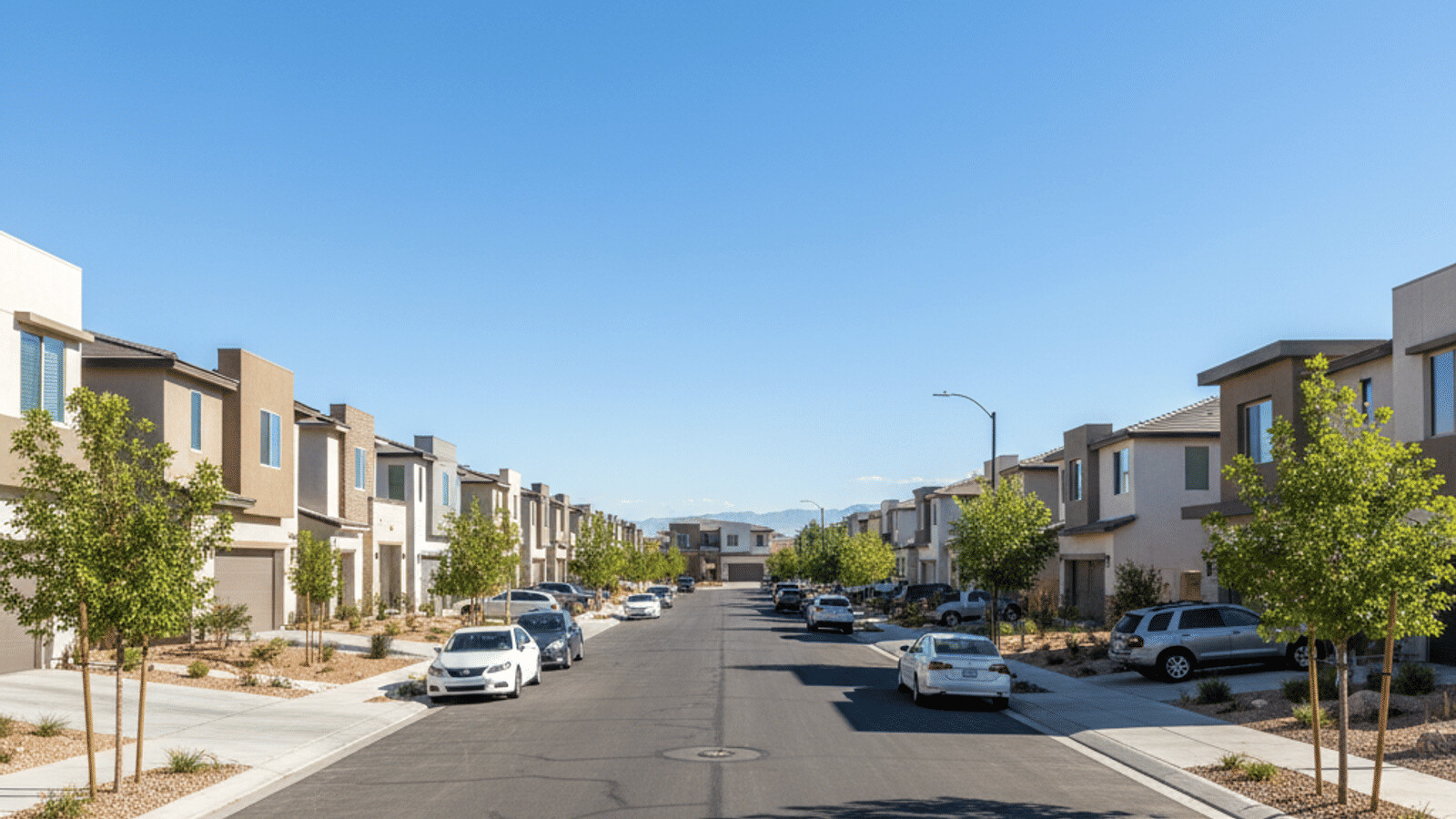
Let's start with the biggest line item in your budget. According to the Las Vegas REALTORS (LVR/GLVAR), the median existing-home sale price in the City of Las Vegas reached approximately $465,000 in the first half of 2026. The North Las Vegas median tracked closer to $385,000 during the same period — a gap of roughly $80,000.
That spread is not purely a quality difference. Some of it reflects geography: North Las Vegas has more land available for entry-level tract homes, which pulls its median down. Some of it reflects age: large portions of central North Las Vegas were built in the 1970s and 1980s and trade at a discount compared to master-planned product. And some of it reflects location premium: Las Vegas properties sit closer to the employment corridors anchored by the Strip, Downtown, and the UNLV/Medical District cluster.
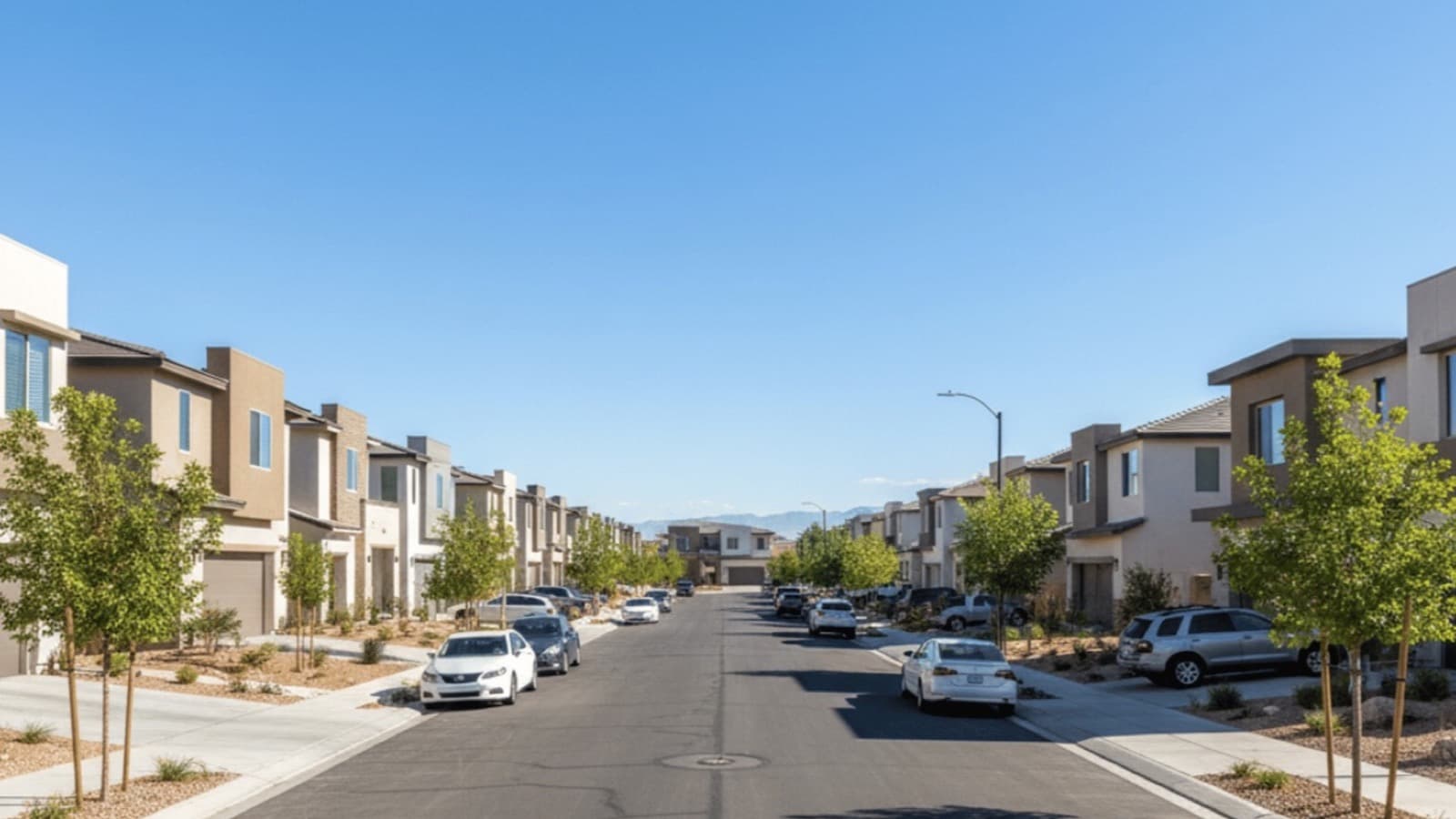
For buyers, this means you can often buy more square footage in North Las Vegas for the same monthly payment. A $400,000 budget that buys roughly 1,700 square feet in a Las Vegas non-HOA neighborhood might stretch to 2,000 square feet of brand-new construction in the Aliante or Valley Vista master plans of North Las Vegas.
If you are planning to rent rather than buy, the rental market tells a similar story. According to Las Vegas REALTORS market data, rental rates in North Las Vegas run approximately 15% to 20% lower than comparable units in desirable Las Vegas neighborhoods. You can often find newer apartment complexes or single-family rentals in North Las Vegas that offer more square footage for the same monthly payment you would make on a smaller unit near the Strip.
| Property Type | Las Vegas | North Las Vegas |
|---|---|---|
| Entry-level single-family | $330,000 – $380,000 | $290,000 – $350,000 |
| Median single-family | approximately $465,000 | approximately $385,000 |
| New construction entry (master-planned) | $420,000 – $550,000 (Summerlin, Skye Canyon) | $350,000 – $480,000 (Aliante, Valley Vista) |
| Luxury single-family (top 10%) | $900,000+ | $600,000+ |
| Typical 2BR rent | $1,550 – $1,900/mo | $1,250 – $1,600/mo |
How Does New Construction Compare Between Las Vegas and North Las Vegas?
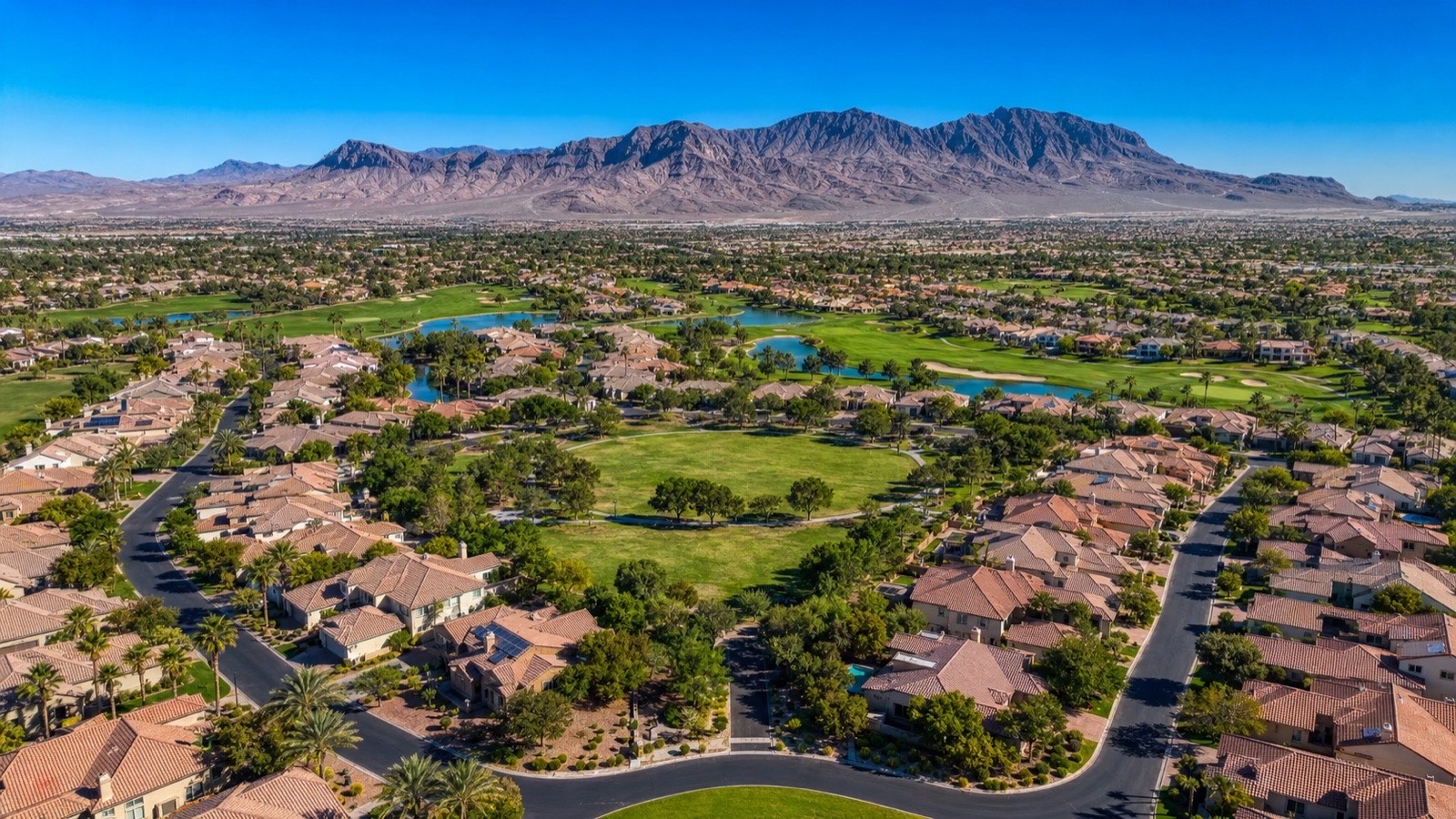
This is the single most underappreciated difference between the two cities — and for buyers in the $350,000 to $500,000 range, it often tips the decision.
According to Clark County Department of Building, North Las Vegas accounted for more than 40% of all new single-family construction permits in Clark County in the first quarter of 2026. The city still has large swaths of undeveloped desert, particularly as you push north of the 215 Beltway toward the Apex corridor. Builders including DR Horton, Lennar, Century Communities, Tri Pointe Homes, and Taylor Morrison are all actively delivering product there.
The flagship communities driving this construction boom are:
Aliante (North Las Vegas) — One of the most established master plans in the north valley, with approximately 12,000 homes at various stages of build-out. Aliante features a golf course, the Aliante Casino + Hotel, a recreation center, a nature discovery park, and miles of pedestrian paths. New-construction pricing typically falls between $360,000 and $480,000, and the community is well served by Shadow Ridge High School, Elise L. Wolff Elementary, and several newer charter options.
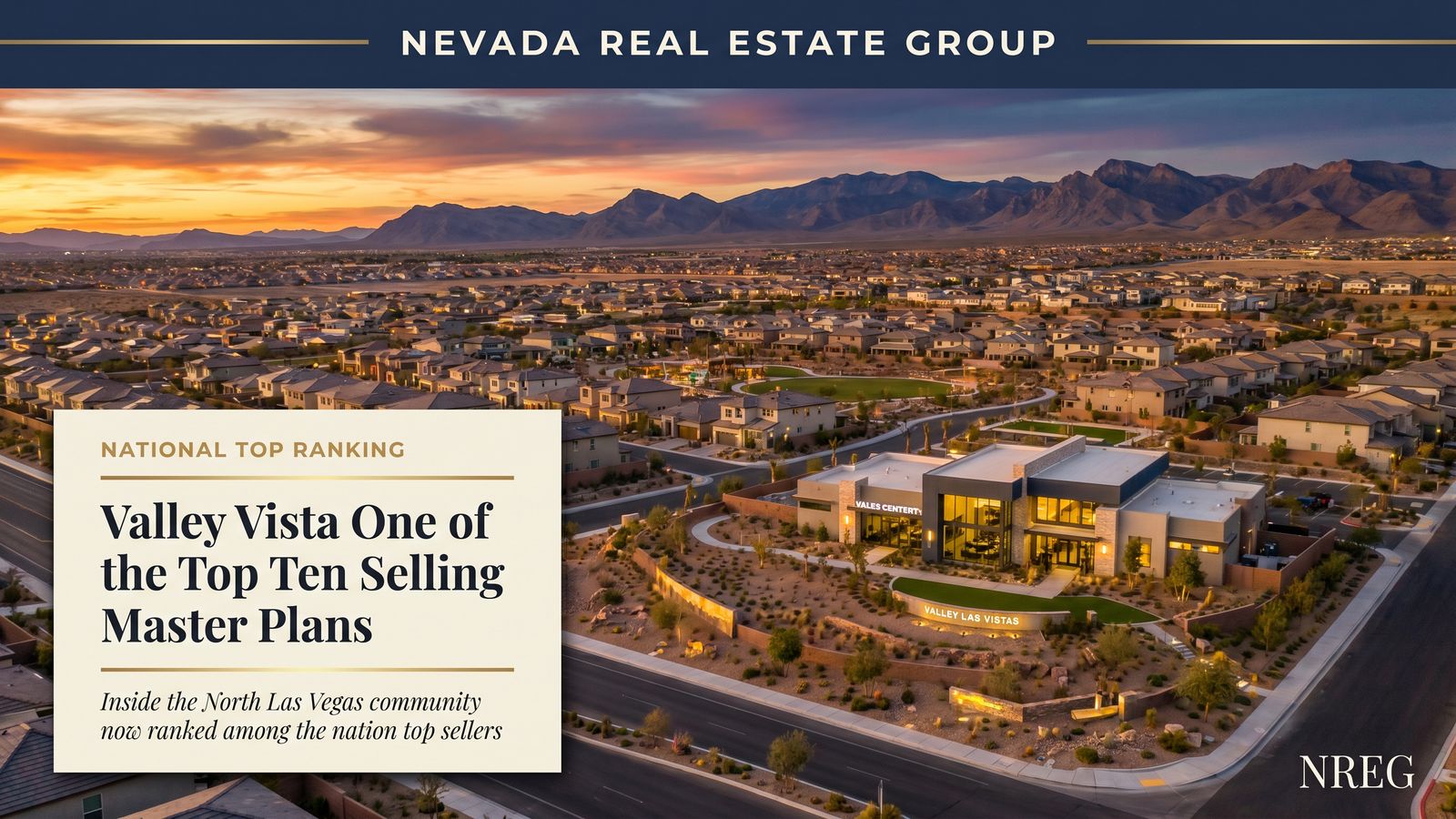
Valley Vista (North Las Vegas) — A newer master plan immediately north of Aliante, with pricing starting around $350,000. Valley Vista is expanding rapidly through 2026 and 2027, with multiple builders offering single-story and two-story floor plans across lots that are generally larger than what you find in comparable Las Vegas infill communities.
Apex Industrial Corridor — While primarily commercial, the industrial expansion in the Apex area has driven population growth further north, creating demand for nearby residential communities in the Carey Boulevard and Losee Road corridors.
By contrast, Las Vegas is becoming somewhat land-locked by its own borders, the Spring Mountains to the west, and the Red Rock Canyon National Conservation Area. Most new Las Vegas development is infill, high-density mixed-use, or premium master-planned product in the far northwest (Skye Canyon, Providence) where land values are already elevated. The result is that new construction in Las Vegas starts higher and competes in a narrower price band.
For buyers who want brand-new appliances, a builder warranty, and modern floor plans — but cannot stretch to Summerlin pricing — explore the new construction inventory and current North Las Vegas homes for sale across the city's master plans.
How Does the Side-by-Side Comparison Stack Up Across All Key Factors?
This tier-versus-tier table captures how Las Vegas and North Las Vegas measure up across the eight factors that matter most to buyers making a real decision in 2026.
| Factor | Las Vegas | North Las Vegas |
|---|---|---|
| Median home price | approximately $465,000 | approximately $385,000 |
| New construction availability | Strong NW (Skye Canyon, Providence) — limited infill elsewhere | Valley-leading — Aliante, Valley Vista, Apex corridor |
| Violent crime (city-wide avg) | Higher in older central corridors; suburbs comparable | Higher in southern older areas; north suburbs comparable |
| School performance | Mixed — top scores in Summerlin and NW; lower in older core | Mixed — newer Aliante/Valley Vista schools perform well; older central NLV lags |
| Strip commute (typical) | 5 – 20 minutes from most residential areas | 20 – 35 minutes from Aliante; 10 – 15 from southern NLV |
| State income tax | None | None |
| Property tax rate (approx) | 3.28% of assessed value | 3.17% of assessed value |
| HOA prevalence | Partial — many non-HOA options exist | Strong in master plans; some non-HOA central areas |
How Does Safety Compare Between Las Vegas and North Las Vegas?
When people ask about safety in the valley, the answer is never a simple yes or no. Both Las Vegas and North Las Vegas have pockets of high activity and areas of genuine suburban quiet. The key is to look at specific zip codes rather than relying on city-wide averages, which can be pulled dramatically by a few high-incident corridors.
According to FBI Uniform Crime Reports, North Las Vegas has historically posted higher city-wide violent crime rates than Las Vegas. However, that city-wide number is heavily influenced by the older, denser, lower-income corridors in the southern and central portions of North Las Vegas — the neighborhoods that border the industrial zone along Owens Avenue and the older tracts near Carey Avenue.
The picture changes significantly when you look at specific zip codes. The 89031 zip code (Aliante, the northern arc of North Las Vegas) and the 89084 zip code (Valley Vista, Eldorado Dunes) consistently show violent crime rates that compare favorably to mid-range Las Vegas suburbs. These master-planned communities were designed with limited-access street networks and defined neighborhood boundaries — layouts that naturally reduce cut-through traffic and deter opportunistic crime.
Las Vegas has its own internal variation. The Strip corridor, Downtown, and the east side precincts carry higher incident rates that inflate the city-wide average. By contrast, Summerlin, the Northwest corridor, Skye Canyon, and Providence register safety statistics that rival some of the safest suburbs in the American West.
The practical takeaway for a buyer in 2026: choosing the right zip code within either city matters far more than the city boundary itself. A buyer in the 89031 zip code of North Las Vegas may live in a safer neighborhood than a buyer in certain central Las Vegas zip codes — at $80,000 less in purchase price.
How Do Schools Compare Between Las Vegas and North Las Vegas?

Both cities are served by the Clark County School District (CCSD), the fifth-largest school district in the nation serving roughly 320,000 students. Because it is a single unified district, the curriculum, standardized testing framework, and administrative policies are consistent across both city borders. You do not switch school districts by moving from Las Vegas to North Las Vegas.
However, individual school performance varies significantly within the district, and those variations often align with the age and income demographics of specific neighborhoods rather than city boundaries.
Las Vegas school picture: The district's highest-ranked schools are concentrated in the Summerlin corridor (Red Rock, The Meadows, Palo Verde High School), the Northwest corridor (Shadow Ridge High School draws from upper North Las Vegas and northwest Las Vegas), and the southwest quadrant. According to the Nevada Department of Education, schools in zip codes 89135 (Summerlin South) and 89144 (Summerlin West) consistently earn four- and five-star ratings on the state's school performance framework. Schools in older central Las Vegas zip codes run from one to three stars.
North Las Vegas school picture: The newer schools built to serve Aliante and Valley Vista — including Elise L. Wolff Elementary, Desert Oasis High School feeder systems, and Valley Vista's incoming school infrastructure — are modern facilities with strong parent engagement. They tend to outperform the older schools in central NLV. Shadow Ridge High School, which technically draws from both the northwest Las Vegas and north Las Vegas boundary, is one of the valley's stronger public options.
For families prioritizing school quality, the Aliante area of North Las Vegas offers a genuine alternative to Las Vegas's suburban school corridors — at a lower entry price. The key is to verify the specific elementary and middle school zones attached to any home you are considering, since CCSD zoning can change and boundaries in high-growth NLV areas have shifted in recent years.
The valley also relies heavily on magnet schools and Career and Technical Academies. These specialized schools accept students by application, transcend city boundaries, and often outperform the best standard zoned options. For families comparing school-district zones while also reviewing active listings, our communities directory lets you filter by area and school zone side by side. Both cities have access to the same magnet network, so this layer of choice is equally available regardless of whether you buy in Las Vegas or North Las Vegas.
How Do Commute Times and Location Compare?
For many residents, the morning drive decides the city. Unless you work remotely, at Nellis Air Force Base, or in the northern industrial logistics corridor, living in North Las Vegas almost always means commuting south.
North Las Vegas commuters relying on I-15 South to reach the Strip or Downtown face the valley's heaviest bottleneck: the Spaghetti Bowl interchange where I-15 meets US-95. From Aliante (the far northern master plans), a non-traffic morning drive to the Strip runs about 25 to 30 minutes. During peak hours, that same drive can stretch to 45 minutes. Residents in the southern portion of North Las Vegas — neighborhoods immediately north of the I-215 interchange — are only 10 to 15 minutes from the Strip with lighter traffic exposure.
Las Vegas commuters have the geographic advantage of already being in the basin. Residents in Summerlin (west Las Vegas), the Northwest, or the southwest are typically 10 to 20 minutes from major employment corridors. The tradeoff is that the I-215 Beltway and US-95 compress all traffic toward the same interchange regardless of your starting point, so peak-hour windows affect everyone.
Nellis Air Force Base factor: If you are active duty or a civilian contractor at Nellis, North Las Vegas is the logical choice. Nellis sits at the eastern edge of North Las Vegas, and commuting from Aliante or Valley Vista to the base involves a straightforward east-west surface street drive — often 15 to 20 minutes — without the freeway bottleneck that plagues Strip commuters.
Transit reality: According to the Regional Transportation Commission of Southern Nevada (RTC), bus service density and frequency is meaningfully higher in Las Vegas than in North Las Vegas. The outer rings of NLV — particularly the far northern master plans — have sparse coverage. If you plan to rely on public transit for daily commuting, Las Vegas's denser route network gives you a clear practical advantage.
How Do Taxes and Hidden Costs Differ Between the Two Cities?
When you are calculating your monthly housing cost, the list price is only the starting line. Here is the full tax and fee picture for each city.
State income tax: Nevada charges no state income tax. This applies equally to Las Vegas and North Las Vegas residents. For buyers moving from California, Oregon, or any high-income-tax state, this is often the most impactful financial change of the relocation — typically worth $5,000 to $25,000+ annually depending on income level. According to the Nevada Department of Taxation, Nevada also exempts Social Security income, pension income, and military retirement pay from state tax.
Property taxes: Nevada caps the annual increase on primary-residence assessed values at approximately 3% per year under state law. The actual tax rate varies slightly by tax district (which funds fire, library, police, and other local services). In practice, Las Vegas property tax rates run approximately 3.28% of assessed value, while North Las Vegas rates run approximately 3.17% of assessed value — a difference of less than one-eighth of one percentage point. On a $400,000 home, that translates to roughly $400 per year in favor of North Las Vegas. Meaningful over time, but not a deciding factor on its own.
HOA fees: Master-planned communities in both cities carry HOA fees. In the Aliante and Valley Vista communities of North Las Vegas, HOA fees typically run $40 to $80 per month — slightly lower than comparable master-planned communities in Las Vegas's Summerlin corridor, where the master HOA (Summerlin Council) and village sub-HOA can combine for $100 to $200+ per month. Las Vegas also has large swaths of pre-1990 neighborhoods with no HOA at all — a meaningful budget advantage for buyers who want to avoid the governance and fees.
SIDs and LIDs in North Las Vegas: If you are buying new construction in North Las Vegas, pay close attention to Special Improvement Districts (SIDs) or Limited Improvement Districts (LIDs). These are assessments attached to the property to repay infrastructure bonds for roads and utilities in new developments. They are very common in NLV's actively developing tracts. A SID or LID can add $50 to $150 per month to your carrying cost on top of your mortgage, taxes, and HOA. Always ask the builder's sales agent for the full SID/LID balance and annual payment schedule before submitting an offer.
Daily cost of living: Outside of housing, your daily expenses will not fluctuate much between cities. NV Energy covers electricity for both jurisdictions. Southwest Gas handles natural gas. Groceries cost roughly the same — Las Vegas has a higher concentration of premium grocers, but the typical Smith's or Albertsons charges nearly identical prices in both cities. Car insurance rates vary by zip code based on local accident and claims data, so get quotes specific to the zip code of your target home.
Which City Is Better for First-Time Buyers?
For most first-time buyers, North Las Vegas offers the better entry point in 2026. The $385,000 median price is approximately $80,000 below Las Vegas, and the active new-construction pipeline in Aliante and Valley Vista means more inventory of homes at the $350,000 to $430,000 price point that dominates first-time buyer purchasing power. You can browse current North Las Vegas homes for sale to see live inventory in that range.
According to the National Association of REALTORS (NAR), first-time buyers nationwide purchase below the local median more than 60% of the time. In Clark County, that means the sub-$400,000 market is the battleground — and North Las Vegas has meaningfully more inventory at that tier than Las Vegas does.
Nevada's first-time buyer assistance programs, offered through the Nevada Housing Division under Nevada Revised Statutes Chapter 319, include the Home Is Possible grant (down payment assistance of up to 4% of the loan amount) and reduced-interest FHA and conventional programs. Our buyers guide walks through each program in detail. These programs work in both cities, but the lower purchase prices in North Las Vegas stretch the assistance dollars further — and keep the monthly payment inside the qualification range for more buyers.
The main caveat: newer first-time buyers attracted by North Las Vegas affordability should budget carefully for SID/LID assessments on new construction. A $360,000 new home in Valley Vista that carries a $100/month SID effectively costs the same as a $370,000 resale home in Las Vegas without the assessment. Always do the apples-to-apples math before assuming new construction in NLV is always the cheaper option.
Which City Is Better for Families?
Both cities serve families well in specific submarkets, but the right answer depends heavily on which sub-neighborhood you are targeting.
Families who prioritize school quality and safety and have the budget for the $380,000 to $480,000 range often land in the Aliante corridor of North Las Vegas. The combination of newer school facilities, lower crime density in the northern zip codes, master-planned parks and paths, and a roughly $80,000 price advantage over comparable Las Vegas family neighborhoods makes Aliante one of the best-value family markets in the valley.
Families who want the highest-ranked schools and are willing to pay the Las Vegas premium should look at Summerlin or the Northwest Las Vegas corridor (Providence, Skye Canyon). These neighborhoods deliver Henderson-equivalent school performance and safety within Las Vegas city limits. Entry prices start around $440,000 in the outer northwest and climb to $600,000+ in established Summerlin villages.
According to the U.S. Census Bureau QuickFacts, North Las Vegas has a higher percentage of households with children under 18 than the Las Vegas city average — reflecting that NLV's affordability draws young families specifically. The city has invested in parks, recreation centers, and youth programming to serve this demographic.
We've represented dozens of families in both cities over the past several years. In our experience, the pattern is consistent: families whose budget maxes out around $430,000 choose North Las Vegas (specifically Aliante) for the new construction, newer school buildings, and suburban character at that price point. Families with $500,000+ budgets who want established prestige neighborhoods lean toward Summerlin.
Which City Is Better for Investors?
The investment calculus between Las Vegas and North Las Vegas tracks closely to the same dynamic as Las Vegas vs Henderson: lower entry price drives gross rent yield; master-planned location drives long-term appreciation. If you plan to sell after your hold period, our sellers resources cover the listing strategy options available in both markets.
Cash-flow investors favor North Las Vegas. The lower purchase prices — often $80,000 to $100,000 below comparable Las Vegas properties — combined with rental demand from the valley's logistics and Nellis workforce produce better gross cap rates. A $380,000 single-family rental in North Las Vegas that rents for $1,800 per month generates a gross yield of approximately 5.7%. A comparable $465,000 Las Vegas home renting for $2,000 per month generates roughly 5.2%.
Appreciation investors looking at 7-to-10-year holds tend to split their preferences. The long-term appreciation case for established Las Vegas master-planned corridors (Summerlin, Northwest) is backed by a track record of consistent demand and supply constraints. The North Las Vegas appreciation case is driven by a different engine: catch-up pricing as the northern master plans mature, Nellis and logistics workforce growth, and the ongoing industrial expansion in the Apex corridor bringing higher-income jobs north.
According to the Federal Housing Finance Agency (FHFA), the Las Vegas-Henderson-Paradise metro appreciated at approximately 6% annually on a compounded 10-year basis through mid-2026 — well above the national average. That metro-wide figure includes North Las Vegas, which has tracked slightly above the metro average during the most recent three-year period as the master-plan premium in Aliante and Valley Vista caught up to Las Vegas sub-market pricing.
For a full picture of current Las Vegas metro housing market dynamics, read our guide to the Las Vegas housing market. For community-level profiles across both cities, browse our communities directory.
What Is the Neighborhood Vibe and Lifestyle Like in Each City?
Once you look past the price tag, the daily feel of each city is the second biggest factor that will decide where you land.
Las Vegas feels like a major metropolitan city: dense, diverse, and busy. The neighborhoods range widely. You have the historic charm of older districts near Downtown and the Arts District, the polished affluence of master-planned Summerlin in the west, and the high-energy proximity to the Strip's celebrated dining scene, entertainment venues, and major sports franchises. The Las Vegas Golden Knights, Raiders, and Athletics all play within the city limits. According to the City of Las Vegas, the city hosts over 200 entertainment events per year in venues anchored within residential Las Vegas proper.
North Las Vegas has a split personality. The southern portion — bordering Downtown Las Vegas — is older, industrial, and denser. However, as you drive north of the 215 Beltway, the vibe changes completely. The northern part of North Las Vegas is defined by master-planned communities like Aliante and Valley Vista, which feel very similar to the suburbs of Henderson or Summerlin but with a quieter, more spacious character. Open lots, wider streets, newer construction, and a pace that is a full step removed from the Strip corridor.
The trade-off is amenity density. Las Vegas dominates on high-end dining, shopping districts, and cultural events. In North Las Vegas, commercial development is still catching up to the residential growth. You will find chain restaurants, big-box stores, and neighborhood strip malls aplenty. For a specific high-end restaurant or boutique shopping experience, you will typically drive 20 to 30 minutes south into Las Vegas. The Aliante Casino + Hotel serves as the main social anchor in the northern part of NLV — movies, dining, gaming — but it operates at a more local scale than the full Las Vegas entertainment ecosystem.
Do Taxes Differ Meaningfully Between Las Vegas and North Las Vegas?
The short answer is: barely. Both cities sit within Clark County's property tax framework, both benefit from Nevada's zero state income tax, and both carry the 3% annual cap on primary-residence assessment increases.
The technical tax rate differences are small. Las Vegas property tax rates average approximately 3.28% of assessed value (which is 35% of taxable value under Nevada law). North Las Vegas rates average approximately 3.17% of assessed value. On a $400,000 home, that gap is roughly $440 per year — meaningful over a 10-year hold ($4,400), but not a city-selection driver on its own.
According to the Nevada Department of Taxation, both cities operate under Nevada Revised Statutes Chapter 361, which sets the statutory ceiling at $3.64 per $100 of assessed value. Both Las Vegas and North Las Vegas sit well below that ceiling.
The bigger tax-adjacent consideration is the SID/LID landscape in North Las Vegas new construction (covered above) and HOA structure. A $70/month HOA in Aliante costs $840 per year — roughly double the property tax rate gap. When comparing total monthly carrying costs, always model out mortgage + taxes + HOA + SID/LID together, not each line in isolation.
The most significant financial advantage is the one Las Vegas and North Las Vegas share equally: Nevada's zero state income tax. Buyers relocating from California, New York, or Illinois typically experience household tax savings of $5,000 to $25,000 per year that dwarf any intra-Nevada city-level tax difference.
Which City Should You Choose? A Decision Framework
Choosing between Las Vegas and North Las Vegas usually comes down to a trade-off between lifestyle preferences and budget. Neither is objectively better, but one is likely better for your specific situation.
Choose North Las Vegas if:
- You are price-sensitive and want the maximum square footage for your budget.
- You want access to the valley's most active new-construction pipeline in the $350,000 to $480,000 range.
- You prefer a quieter, suburban lifestyle away from the 24/7 energy of the tourist corridors.
- You work at Nellis Air Force Base or in the northern industrial logistics sector.
- You want newer housing stock and are comfortable driving 20 to 30 minutes for high-end amenities.
- You are a first-time buyer with a sub-$420,000 budget who wants new construction over resale.
Choose Las Vegas if:
- You prioritize a short commute to the Strip, Downtown, or the central employment corridor.
- You want access to established luxury communities like Summerlin or Skye Canyon.
- You prefer a dense, amenity-rich environment where diverse dining and entertainment are minutes away.
- You are seeking specific private school options or a guard-gated community — Las Vegas holds the advantage in both private school density and gated enclave options.
- You are an investor targeting gross rent yield over $450,000 — the Las Vegas price tier unlocks a broader pool of qualified tenants. See our best neighborhoods in Las Vegas guide for neighborhood-level investment context.
| Buyer Type | Better City | Key Reason |
|---|---|---|
| First-time buyers under $420,000 | North Las Vegas | Broader sub-$400K inventory and active new-construction pipeline |
| Families seeking established master plans | Las Vegas (Summerlin / NW) | Higher-ranked schools, established parks, broader private school options |
| Families on a $380,000–$460,000 budget | North Las Vegas (Aliante) | New construction, modern schools, lower entry price than comparable LV suburbs |
| Nellis AFB / logistics workers | North Las Vegas | 15–20 minute surface street commute to base; no freeway bottleneck |
| Strip / Downtown workers | Las Vegas | 5–20 min commute vs 25–40 min from Aliante |
| Cash-flow investors | North Las Vegas | Lower entry price produces better gross rent yield on the same rental income |
| Long-term appreciation investors | Either — depends on submarket | Summerlin (LV) has the track record; Aliante/Valley Vista have the catch-up trajectory |
Across our 9,600-plus closings in Clark County, the most common pattern is straightforward: buyers with budget flexibility and school-age children move toward Las Vegas's established northwest master plans; budget-first buyers and Nellis/logistics workers land in North Las Vegas's northern master plans. The best decision depends entirely on your specific commute, school needs, and monthly payment limit. Call us at (702) 637-1759 or reach us online and we will model both scenarios against your numbers. Learn more about our team and the full Clark County market coverage Nevada Real Estate Group provides.
Frequently Asked Questions About Las Vegas vs North Las Vegas
Is North Las Vegas cheaper than Las Vegas?
Yes, consistently. The median home price in North Las Vegas ran approximately $385,000 in mid-2026, compared to approximately $465,000 in Las Vegas — a gap of roughly $80,000. Rental rates in North Las Vegas are also approximately 15% to 20% lower for comparable unit types. New-construction pricing in North Las Vegas master plans (Aliante, Valley Vista) typically starts $60,000 to $90,000 below comparable new product in Summerlin or Skye Canyon.
Is North Las Vegas a separate city from Las Vegas?
Yes. North Las Vegas is an independent incorporated municipality with its own mayor, city council, police department (NLVPD), water utility, and city code. It is not a neighborhood within Las Vegas. The two cities share Clark County's school district, assessor, and tax framework — but they are governed entirely separately at the city level.
How far is North Las Vegas from the Las Vegas Strip?
It depends on where in North Las Vegas you start. From the southern edge of North Las Vegas, you can reach the Strip in roughly 10 to 15 minutes with light traffic. From the Aliante master plan in the far north, the same trip takes 25 to 35 minutes under normal conditions and up to 45 minutes during morning rush hour via I-15 South. According to the City of North Las Vegas, the city spans approximately 100 square miles, so location within NLV matters enormously.
Does North Las Vegas have its own police force?
Yes. The North Las Vegas Police Department (NLVPD) serves the city independently from the Las Vegas Metropolitan Police Department (LVMPD), which covers the City of Las Vegas and the unincorporated areas of Clark County. North Las Vegas also operates its own fire department and city court system.
Are there good schools in North Las Vegas?
Yes — specifically in the Aliante and Valley Vista corridors in the northern part of the city. Schools in those zip codes (89031, 89084) were built after 2005 and feature modern facilities. According to CCSD's performance data, newer schools in Aliante, including Elise L. Wolff Elementary and the Shadow Ridge High School feeder system, score respectably on Nevada's state school rating framework. Older schools in central and southern North Las Vegas (zip codes 89030, 89032) lag behind the district average.
What are SIDs and LIDs in North Las Vegas?
Special Improvement Districts (SIDs) and Limited Improvement Districts (LIDs) are property-level debt instruments used to fund infrastructure in new developments — roads, sidewalks, drainage, utilities. They are attached to the property and transfer with ownership at sale unless the seller has paid them off. In North Las Vegas new-construction communities, an outstanding SID or LID typically adds $50 to $150 per month to your carrying costs. Always ask the builder's agent for the full SID/LID balance and payment schedule before making an offer on any North Las Vegas new-construction home.
Which city is better for real estate investment?
North Las Vegas offers better gross rent yields (lower entry price relative to comparable rents), while Las Vegas master-planned corridors offer a stronger appreciation track record with established demand. According to the Bureau of Labor Statistics, the Las Vegas-Henderson metro labor market employs roughly 1.1 million workers with strong growth in hospitality, healthcare, logistics, and tech — a broad employment base that supports rental demand in both cities. Call (702) 637-1759 for a personalized investor analysis.
Which Sources Inform This Las Vegas vs North Las Vegas Guide?
All data in this guide draws from public agency records, professional REALTOR association reports, and government statistical sources. No competitor listing portals were used.
- Las Vegas REALTORS (LVR/GLVAR) — Market Statistics Reports
- U.S. Census Bureau — North Las Vegas City QuickFacts
- U.S. Census Bureau — Las Vegas City QuickFacts
- Clark County School District — School Performance Data
- Clark County Department of Building — Construction Permit Data
- City of North Las Vegas — Official City Portal
- City of Las Vegas — Official City Portal
- FBI Uniform Crime Reports — Nevada
- Nevada Department of Taxation — Property Tax Rates
- Bureau of Labor Statistics — Las Vegas-Henderson Metro Employment
- National Association of REALTORS — First-Time Buyer Research
- Federal Housing Finance Agency — Home Price Index
- Regional Transportation Commission of Southern Nevada
This guide reflects market data current as of mid-2026 and is intended for informational purposes only. Real estate market conditions change; consult a licensed Nevada real estate professional before making any purchase decision. Nevada Real Estate Group · Chris Nevada · License S.181401 · (702) 637-1759 · 8945 W Russell Rd, Suite 170, Las Vegas, NV 89148.