
Published January 22, 2026 · Updated June 16, 2026 · By Chris Nevada, Nevada Real Estate Group · NV License S.181401
The Las Vegas housing market in 2026 is transitioning toward balance, with median home prices in Clark County at $420,000–$460,000 and active inventory at 3,000–4,500 listings. According to Las Vegas REALTORS (LVR/GLVAR), average days on market sits at 35–55 days — up from the 14-day frenzy of 2021–2022. Buyers have real negotiating leverage again. Call (702) 637-1759 for a free market analysis.
- Clark County median: $420,000–$460,000 in 2026; Henderson commands $455,000–$510,000; North Las Vegas entry at $360,000–$400,000.
- Active inventory at 3,000–4,500 listings gives buyers real leverage for the first time since 2019.
- Nevada zero income tax saves California households $8,000–$20,000 annually.
- Builder incentives — rate buydowns to 4%–5% plus closing cost coverage — cut true cost by $30,000–$80,000.
- Call (702) 637-1759 — Nevada Real Estate Group, #1 Nevada team with 9,600+ closings and $4.85B in sales.
If you have been watching the local headlines lately, the Las Vegas real estate market is finally sending clearer signals. After years of wild swings — from the post-pandemic frenzy of 2021–2022 to the interest-rate shock of 2023 — 2026 has settled into something that looks, for the first time in a long time, like a balanced market. That shift changes the playbook for buyers and sellers alike, and if you are planning to make a move in Southern Nevada this year, understanding the mechanics of this market is non-negotiable.
Across the 9,600-plus closings Nevada Real Estate Group — the #1 real estate team in Nevada — has represented, we have seen every phase of the Las Vegas market cycle. What we are watching in 2026 is not a crash, not a rebound, and not a bubble. It is a calibration. The data tells a nuanced story that differs significantly by submarket, price tier, and property type. This guide walks through all of it. For our forward-looking forecast with rate scenarios and submarket projections, see the companion Las Vegas housing market 2026 forecast.
What Is the Las Vegas Housing Market Like in 2026?
The Las Vegas housing market in 2026 is best described as a market in transition. The extreme seller leverage of 2021–2022, when homes sold in days with no contingencies and over-ask offers, gave way to a cooling period in 2023–2024 as mortgage rates climbed above 7%. Now, in 2026, the market has found an uneasy equilibrium: rates have partially retreated, inventory has rebuilt, and buyer and seller expectations have recalibrated.
According to Las Vegas REALTORS (LVR/GLVAR), the Clark County market ended 2025 with roughly 4 months of housing supply — the textbook definition of a balanced market is 3–6 months. Single-family home prices have stabilized in the $420,000–$470,000 median range across the broader metro, though pockets like Summerlin and Green Valley in Henderson continue to command meaningful premiums.
What makes 2026 distinct from 2023–2024 is the momentum shift: inventory is no longer building rapidly, and well-positioned homes are once again finding buyers within 30–45 days. The desperation of 2021 is gone, but so is the paralysis of 2023. Sellers who price correctly — within 2%–3% of actual market value — are still seeing competitive activity in the first two weeks.
For buyers, this is the most opportunity-rich environment since 2019. Contingencies are back. Inspections are back. Seller concessions are available on roughly 35%–45% of all closed transactions in Clark County, according to LVR data. The leverage returned to the buy side in late 2024 and has remained there into 2026.
Are Las Vegas Home Prices Rising or Falling?
The honest answer is: it depends where you look. The Las Vegas metro is not one homogeneous market — it is a collection of 15-plus distinct submarckets with very different supply, demand, and buyer profiles. Use our home search to filter by submarket and price tier, or explore the luxury communities directory if your budget exceeds $700,000.
Across Clark County overall, the Federal Housing Finance Agency (FHFA) House Price Index shows Southern Nevada appreciation running at approximately 3%–5% year-over-year through early 2026 — a healthy but not frenzied pace. That compares with the 20%–30% annual appreciation of 2021 and the flat-to-slightly-negative conditions of late 2023.
For single-family homes, the median price has held in the $420,000–$470,000 range across Clark County. Entry-level inventory under $380,000 is extremely scarce — much of what existed in that tier was absorbed by investors and first-time buyers during the low-rate era, and new construction at that price point is essentially unavailable due to land and labor costs.
The condo and townhome market tells a more complicated story. Median condo prices dropped approximately 5%–8% from 2023 peaks due to a combination of HOA fee pressures, rising insurance costs, and reduced investor appetite at higher rates. However, the right condo — well-maintained, low HOA dues, strong reserve fund — is still a viable entry point for buyers who understand the trade-offs.
New construction pricing has remained remarkably stable on paper, but that stability is artificial. Builders are maintaining list prices while offering $30,000–$80,000 in incentives that effectively reduce the buyer's true cost without showing up in the comparable sale data. According to Freddie Mac, the average 30-year fixed rate in 2026 has ranged from 6.2%–7.0%, which means a $450,000 purchase at 6.5% with 10% down carries a principal-and-interest payment of approximately $2,561 per month — still manageable for dual-income households relocating from higher-cost markets.

Is It a Buyer's or Seller's Market in Las Vegas Right Now?
The short answer is: balanced, with a slight lean toward buyers depending on the submarket and price tier.
At roughly 4 months of supply, Clark County sits squarely in the "balanced" range. However, the balance is uneven. In the $350,000–$500,000 tier — where the majority of transactions occur — buyers have the most leverage, with ample selection and seller-paid concessions commonly on the table. In the $700,000–$1.2 million luxury move-up range, supply is tighter, and well-maintained homes in premium communities like Summerlin or MacDonald Highlands can still generate multiple offers within the first 10 days.
The market is therefore not uniformly buyer-favorable or seller-favorable — it is price-tier-specific. In our experience handling hundreds of Las Vegas transactions in 2025, buyers who moved with confidence in the $400,000–$550,000 tier consistently secured $10,000–$20,000 in seller concessions toward closing costs and rate buydowns. Sellers who overpriced by more than 3%–4% faced extended days on market and eventual price reductions that often landed them below where a correct initial price would have set the anchor.
| Submarket | Median Price | Avg Days on Market | Year-over-Year Change |
|---|---|---|---|
| Las Vegas (city core) | $415,000–$445,000 | 35–45 days | +3%–5% |
| Henderson | $455,000–$510,000 | 28–38 days | +4%–6% |
| Summerlin / NW Las Vegas | $520,000–$650,000 | 22–35 days | +5%–7% |
| North Las Vegas | $360,000–$400,000 | 38–55 days | +2%–4% |
| Boulder City | $380,000–$440,000 | 40–60 days | +1%–3% |
| Enterprise / SW Las Vegas | $430,000–$490,000 | 30–42 days | +3%–5% |
How Have Mortgage Rates Affected Las Vegas Home Buyers?
Mortgage rates are the single biggest variable shaping the 2026 Las Vegas market. According to Freddie Mac's Primary Mortgage Market Survey, the 30-year fixed rate peaked above 8% in late 2023 and has since retreated to the 6.2%–7.0% range as of mid-2026. That partial relief has unlocked some demand that was frozen on the sidelines, but rates remain well above the 3%–4% range that defined 2020–2021.
The practical impact on a Las Vegas buyer in 2026 looks like this:
At $450,000 purchase price with 10% down ($405,000 loan):
- At 3.5% (2021 era): approximately $1,819/month principal + interest
- At 6.5% (2026): approximately $2,561/month principal + interest
- Difference: approximately $742/month, or $8,904/year
That delta explains the affordability strain — but it does not tell the full story. Las Vegas buyers in 2026 have three tools that did not exist in 2021: seller concessions (available on roughly 40% of transactions), builder rate buydowns (getting buyers into the 4%–5% range on new construction), and the "marry the house, date the rate" refinance option as rates continue their slow descent.
According to HUD, first-time buyers still account for a meaningful share of Las Vegas transactions, with FHA loans (minimum 3.5% down, $524,225 loan limit in Clark County for 2026) remaining the most common entry-level vehicle. Veterans using VA loans — a significant cohort given Nevada's large military-adjacent population — access the market with zero down payment and competitive rates, making North Las Vegas and certain Henderson submarkets their primary entry points.
In 2025, Nevada Real Estate Group closed 789 homes totaling more than $440 million in Southern Nevada sales volume. Across those transactions, we watched the buyers who got pre-approved, moved decisively, and used the current concession environment strategically consistently outperform those who waited for rates to drop further. The wait-for-6%-rates game lost ground every quarter that appreciation continued at 3%–5%.
What Should Buyers Expect When Shopping in Las Vegas in 2026?
If you have not bought in Las Vegas since 2020 or earlier, the experience is markedly different today. Here is what to expect:
Realistic inspection rights are back. In 2021, waiving inspection contingencies was table stakes. In 2026, inspection contingencies are standard. Buyers routinely negotiate repair credits of $3,000–$8,000 on inspections that surface deferred maintenance, roof age, or HVAC condition issues. In our experience, the average Las Vegas inspection negotiation in 2025 saved buyers approximately $4,200 in immediate repair costs or equivalent credits.
Appraisal gaps have largely closed. During the frenzy, buyers routinely had to cover $20,000–$50,000 appraisal gaps in cash. With prices stabilized and appraisers catching up to transaction data, appraisal gap clauses are far less common in 2026. Most well-priced homes appraise at or within 2%–3% of contract price.
Closing cost coverage is widely available. According to LVR data, seller-paid concessions appear in approximately 35%–45% of Clark County transactions in 2026. A skilled buyer's agent — and we have over 150 agents at Nevada Real Estate Group who handle Las Vegas negotiations daily — can routinely negotiate $5,000–$12,000 toward buyer closing costs or a rate buydown, effectively lowering the monthly payment by $40–$80/month for the life of the loan.
Multiple-offer situations still exist, but selectively. Move-in-ready homes priced within fair market value in desirable schools zones, particularly in Henderson and Summerlin, still attract 3–6 offers in the first week. Buyers who are not pre-approved with a strong lender letter will lose these homes to better-prepared buyers who are.
See our Las Vegas FHA loan guide for a deep dive on financing options for first-time buyers in Clark County. Buyers considering North Las Vegas will find the most accessible price points in the metro, while Summerlin and Henderson offer the strongest long-term appreciation story.
What Should Sellers Know About Pricing a Las Vegas Home?
If you are selling a Las Vegas home in 2026, one number matters above all others: your list price relative to recent comparable sales (comps) within the last 90 days in your neighborhood. The market has become highly efficient at punishing overpricing and rewarding precision.
According to LVR statistics, homes that list within 2%–3% of market value close in approximately 28–40 days and typically receive 97%–101% of list price. Homes that list 5%–8% above market sit for 60–90 days, accumulate stigma as buyers wonder what is wrong with the property, and eventually close at 92%–95% of the original list — meaning the seller ends up netting less than they would have with a correct initial price.
The pricing discipline required in 2026 is harder than it sounds. Nevada has no state income tax, which means sellers often have significant equity after years of appreciation — a $450,000 home bought in 2019 for $300,000 has $150,000 in gains. That equity build creates anchoring bias: sellers mentally anchor to a number that feels "fair" but may not match what the current buyer pool will support.
For a complete guide to listing strategy, visit our sellers resource center. Key pricing factors for Las Vegas sellers in 2026:
- Recent comp window: use 60–90 day comps maximum; 2023–2024 data is dangerously stale in many pockets
- Condition premium: move-in-ready homes with updated kitchens and new HVAC can justify $10,000–$25,000 above base comps; deferred-maintenance homes will face buyer credits that offset that
- HOA disclosure timing: Clark County disclosure requirements under Nevada Revised Statutes Chapter 116 mandate complete HOA package delivery within 10 days of contract execution — a common contract extension trigger that can be avoided with proactive disclosure prep
How Does New Construction Affect the Las Vegas Market?
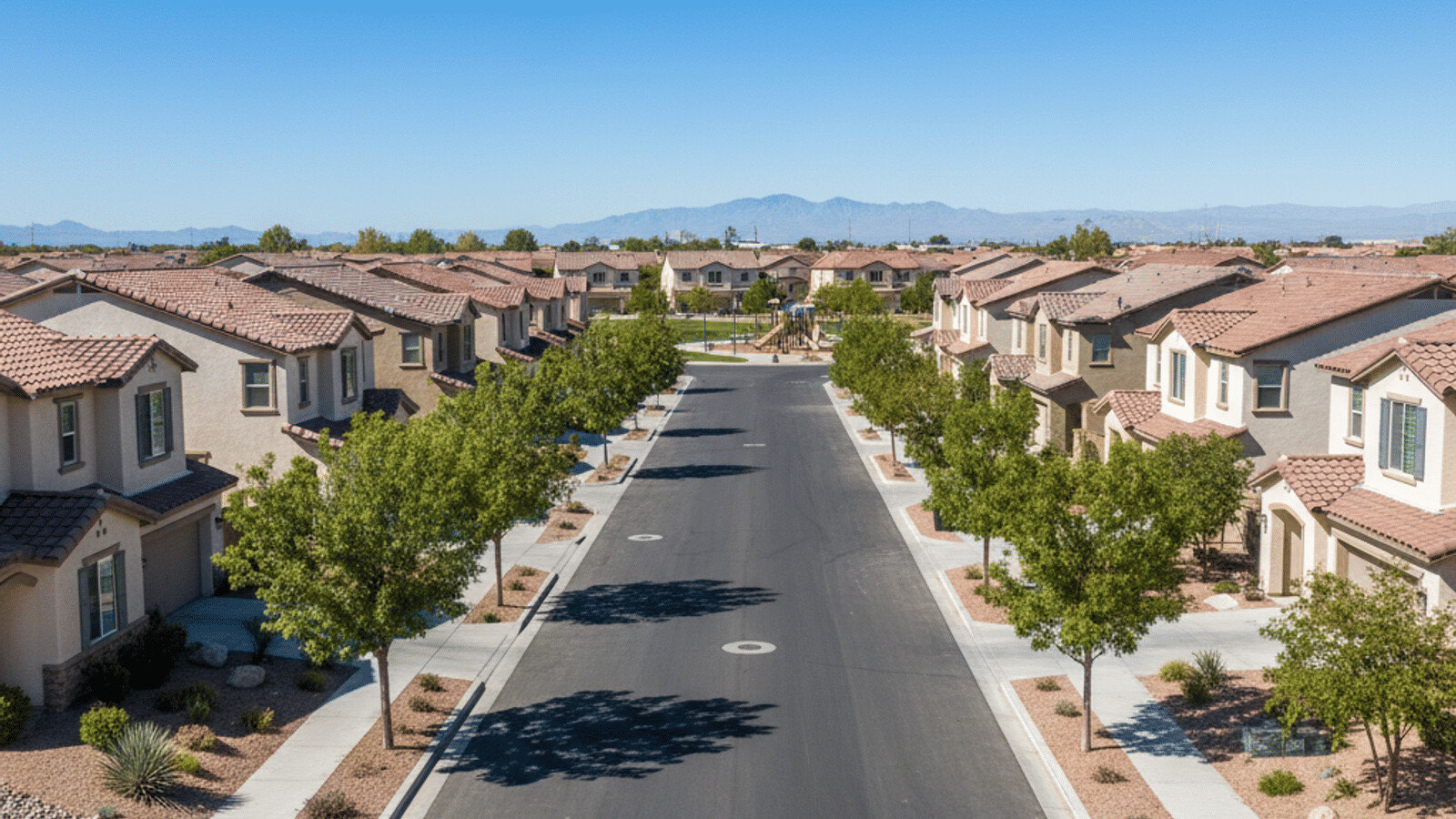
New construction is the wild card that makes Las Vegas different from most major markets. The Mojave Desert surrounding the valley provides ample buildable land, and Nevada's regulatory environment for residential development is relatively permissive compared to California, which keeps production moving even when resale inventory tightens.
The major builders active in Clark County in 2026 — KB Home, Lennar, Toll Brothers, Pulte, Taylor Morrison, and Richmond American — collectively add approximately 8,000–12,000 new homes per year to the Southern Nevada inventory. First-time buyers who want to explore builder communities can search active Las Vegas listings or browse the Henderson new homes section for builder-incentive inventory near top-rated CCSD schools. That volume has a moderating effect on price appreciation in the mass-market tier ($380,000–$600,000), because there is always a newly finished home available as an alternative to resale.
The builder incentive dynamic is critical to understand in 2026. Builders will not lower base prices because doing so resets comps for their existing community and for the buyers who already closed. Instead, they run concession programs that can include:
- Permanent rate buydowns to 4.5%–5.25% via builder-affiliated lenders (effective payment savings of $300–$500/month on a $450,000 home)
- Full closing cost coverage (typically $8,000–$15,000)
- Design center allowances of $10,000–$25,000 for upgrades
- Free lot premium upgrades valued at $5,000–$15,000
The catch: builder incentives are tied to using their preferred lender, which may not offer the best market rate on a conventional purchase. Smart buyers in 2026 get a competing quote from an independent lender and use it as leverage to negotiate additional incentives even when the builder's preferred lender is the right choice.
According to the Clark County Department of Building, residential permit volumes in 2025 tracked slightly below 2024 levels as builders managed supply to avoid the overbuilding error of 2006–2007. This disciplined production is a key reason the Las Vegas market has avoided the distressed-inventory surge that plagued the post-2008 collapse.
Which Las Vegas Areas Are Appreciating Fastest in 2026?
Appreciation in 2026 is not uniform — it is concentrated in three categories: master-planned communities with strong HOAs and amenities, areas near major employment corridors, and new-construction communities where builder activity creates its own demand momentum.
Summerlin (western Las Vegas valley): The Howard Hughes Corporation continues to develop new villages and commercial nodes in the 22,500-acre master plan, attracting high-income professionals and corporate relocations. Appreciation in Summerlin has run 5%–7% year-over-year, supported by top-rated schools under Clark County School District (CCSD), Red Rock Canyon access, and the Downtown Summerlin retail core. Median prices range from $520,000 to well over $1 million in The Ridges and Tournament Hills.
Henderson's Green Valley and Inspirada: Henderson benefits from its reputation as Clark County's safest large city and the continued development of Water Street District. According to the U.S. Bureau of Labor Statistics, the Las Vegas metro added approximately 28,000–35,000 net jobs in 2025, with above-average growth in healthcare and logistics — both sectors concentrated near Henderson's employment core. Green Valley Ranch, Inspirada, and the Trilogy at Sunstone 55-plus community are all appreciating at the higher end of the market range.
North Las Vegas near the Apex industrial corridor: The least discussed appreciation story in Clark County in 2026 is the industrial-employment-driven demand near the Apex Industrial Park, Faraday Future's site, and the expanding Amazon logistics footprint. Entry-level buyers priced out of Henderson and Summerlin have turned North Las Vegas into a competitive submarket, pushing appreciation toward 4%–6% in communities near the NV 215 Beltway.
See our cost of living in Las Vegas guide for a deeper look at how these area price differences translate into total housing cost. The Las Vegas metro's geographic diversity — from North Las Vegas to Henderson — means every budget tier has a viable entry point.
How Does Nevada's Tax Climate Compare to California and Arizona?
For buyers relocating to Las Vegas from California or Arizona, the tax math is a major part of the total-cost-of-homeownership equation — and it moves heavily in Nevada's favor.
According to the Nevada Department of Taxation, Nevada levies no state income tax whatsoever. This means wages, freelance income, capital gains (beyond the federal level), retirement account distributions, Social Security benefits, and pension income are all free from state-level tax. A California household earning $200,000 per year faces an approximate state income tax burden of $14,000–$18,000 under California's rate structure (up to 13.3%). That same household in Las Vegas keeps the entire $200,000 at the state level — a recurring annual advantage of $14,000–$18,000 per year, every year, for as long as they remain Nevada residents.
Nevada also caps property tax increases on owner-occupied primary residences under Nevada Revised Statutes Chapter 361. The effective property tax rate in Clark County averages approximately 0.6%–0.8% of assessed value — meaning a $450,000 home carries annual property taxes of approximately $2,700–$3,600. By comparison, a comparable home in a California coastal market might carry property taxes of $5,500–$9,000 per year at the same assessed value, plus Mello-Roos and special district assessments.
| Tax / Cost Category | Nevada (Las Vegas) | California | Arizona |
|---|---|---|---|
| State income tax | 0% | Up to 13.3% | 2.5% flat |
| Social Security income tax | None | None (state) | None (state) |
| Property tax rate (approx.) | 0.6%–0.8% | 1.0%–1.5%+ (Mello-Roos) | 0.6%–0.7% |
| Estate / inheritance tax | None | None (state) | None |
| Annual tax on $200K income | $0 state | $14,000–$18,000+ | $5,000 |
| Median home price (metro) | $440,000 | $750,000–$900,000+ | $410,000–$460,000 |
What Are the Most Affordable Las Vegas Neighborhoods for First-Time Buyers?
The first-time buyer market in Las Vegas in 2026 is real, though challenging. At median prices of $420,000–$460,000 and rates in the 6%–7% range, the monthly payment math requires either a dual income, significant down payment savings, or creative use of assistance programs.
The most accessible submarkets for first-time buyers in 2026. First-timers should also browse the buyers guide for a step-by-step overview of the Nevada purchase process, and visit the communities directory for a full map of every Clark County submarket.
North Las Vegas ($360,000–$400,000 median): North Las Vegas remains the value leader in Clark County, offering the most square footage per dollar of any incorporated area in the metro. The NLV City Council has actively invested in downtown revitalization, and the industrial employment corridor near the Apex zone supports strong job growth. First-time buyers using FHA financing (3.5% down on a $380,000 home = approximately $13,300 down) can get into the market here with realistic monthly payments of approximately $2,200–$2,400 including taxes and HOA.
Enterprise and Spring Valley (SW Las Vegas, $415,000–$445,000 median): These unincorporated Clark County communities off the southwest I-215 Beltway offer good school options, established infrastructure, and shorter commutes to the Strip employment corridor and Las Vegas Athletic Club clusters. Entry-level inventory has tightened since 2022 but is still more accessible than Henderson or Summerlin.
Anthem (Henderson, $400,000–$450,000 entry): The entry level of Anthem by Del Webb provides access to Henderson's premium school ratings and safety statistics at a price point that first-time buyers who have saved a 5%–10% down payment can realistically reach.
Nevada Housing Division programs: According to HUD, Nevada offers the Home Is Possible (HIP) down payment assistance program for qualifying buyers, providing up to 5% of the loan amount as a forgivable second lien. HIP income limits for Clark County in 2026 allow moderate-income households earning up to approximately $105,000–$115,000 (depending on household size) to qualify — a meaningful tool for first-time buyers who have the income for the payment but not the liquid savings for a full down payment.
Our buying a home in Henderson guide covers the FHA, VA, and conventional program options in depth for first-time buyers targeting Clark County's most popular submarket. For renters weighing their options, our average rent in Las Vegas guide provides a side-by-side cost comparison across Henderson, Summerlin, and the urban core of Las Vegas.
How Long Does It Take to Buy a Home in Las Vegas?
The Las Vegas transaction timeline in 2026 typically runs 30–45 days from accepted offer to close of escrow for a standard financed purchase. Buyers exploring new construction should note that spec homes close in 21–30 days while to-be-built homes take 5–9 months. Families relocating to Las Vegas for the first time will find our community guides for Henderson, Summerlin, and North Las Vegas an essential starting point. Here is how that typically breaks down:
- Days 1–3: Accepted offer, earnest money deposited (typically $3,000–$7,000 on a $400,000–$500,000 purchase)
- Days 3–10: Home inspection ($300–$500 for a standard inspection; $150–$200 additional for sewer scope or pool inspection)
- Days 5–10: Appraisal ordered by lender
- Days 10–14: Inspection negotiation resolved; repair credits or price adjustments agreed
- Days 14–21: Appraisal completed and reviewed; lender underwriting in progress
- Days 21–30: Loan approval; title work completed; HOA disclosure package reviewed (Nevada law requires delivery within 10 days of contract execution)
- Days 28–35: Final walkthrough; closing documents reviewed
- Days 30–45: Funding and recording; keys handed over
Cash transactions close faster — typically 15–21 days — and represent approximately 25%–30% of all Clark County closings in 2026, according to LVR data. Cash buyers carry significant leverage in multiple-offer situations because sellers value the certainty of a cash close.
New construction timelines are longer: spec homes (already built) can close in 21–30 days, while to-be-built homes on a selected lot typically require 5–9 months from contract execution to completion, depending on the builder and community phase.

What Is the Rental Market Doing in Las Vegas?
The Las Vegas rental market in 2026 is at an inflection point. Renters weighing the rent vs. buy decision will find the math increasingly favoring ownership for households planning a 5-plus-year stay. For a full look at what Clark County offers across every price tier, explore the communities directory or request a search on Las Vegas homes for sale. After years of aggressive rent growth (median rents climbed approximately 30%–40% from 2020 to 2023 peaks), the pipeline of new multi-family supply has pushed vacancy rates modestly higher and taken the edge off further rent increases.
According to the U.S. Census Bureau, Clark County's rental vacancy rate has risen from near-record lows of approximately 4% in 2022 to approximately 6%–7% in 2026 — still below the national average but high enough to give renters meaningful negotiating power on lease terms, particularly for units in newer Class A apartment complexes.
Average rents in Las Vegas in 2026:
- Studio / 1-bedroom: approximately $1,200–$1,500/month
- 2-bedroom apartment: approximately $1,500–$1,900/month
- 3-bedroom single-family rental: approximately $2,000–$2,600/month
- Luxury 2-bedroom in Summerlin or Henderson: approximately $2,200–$3,200/month
For our complete breakdown of the rental market by area and unit type, see our average rent in Las Vegas guide.
The rent-vs-buy calculation in 2026 hinges heavily on timeline. Contact Nevada Real Estate Group for a custom rent-vs-buy model tailored to your income, savings, and timeline in any Clark County submarket. For buyers who plan to stay 5+ years, ownership builds equity and locks in a fixed payment — while rents continue to trend upward over time. According to the BLS, the Las Vegas metro's shelter cost index has risen approximately 3.5%–5% annually over the past five years, meaning a $1,700/month rent in 2021 has inflated to approximately $2,100–$2,200 in 2026. A fixed 30-year mortgage payment does not inflate — it holds steady regardless of what the rental market does.
The break-even horizon for buying vs. renting in Las Vegas at 2026 prices and rates is approximately 3–5 years for most scenarios, assuming modest 3%–4% annual appreciation and accounting for closing costs, maintenance reserves, and the opportunity cost of the down payment. Nevada Real Estate Group can run a custom rent-vs-buy analysis for any buyer — call (702) 637-1759.
| Price Tier | What You Get in Las Vegas 2026 | Typical Locations | Typical Buyer Profile |
|---|---|---|---|
| Under $380,000 | 2–3 bed, 1,200–1,600 sqft older resale; some distressed or dated condition | North LV, older Henderson, E. Las Vegas | First-time buyer using FHA or VA financing |
| $380,000–$500,000 | 3–4 bed, 1,800–2,400 sqft; new construction starts or quality resale | North LV, Spring Valley, Enterprise, E. Henderson | Move-up buyer; dual-income first-timers; relocating families |
| $500,000–$750,000 | 4 bed, 2,400–3,200 sqft; newer construction, strong school zone | Henderson, Summerlin East, Aliante, Mountains Edge | Mid-market move-up; California relocatees; professionals |
| $750,000–$1.2M | 4–5 bed, 3,000–4,500 sqft; premium master-planned community | Summerlin The Cliffs/Redpoint; Green Valley Ranch; MacDonald Ranch | High-income professionals; executive relocations; equity-rich sellers |
| Over $1.2M | Custom or semi-custom estates; guard-gated community access | The Ridges, Tournament Hills, MacDonald Highlands, Ascaya | Luxury buyers; cash purchasers; high-net-worth relocatees |
Frequently Asked Questions About the Las Vegas Housing Market
What is the average home price in Las Vegas in 2026?
Median home prices across Clark County range from approximately $420,000 to $460,000 in 2026, according to Las Vegas REALTORS (LVR/GLVAR). Henderson commands a premium at $455,000–$510,000 median, while North Las Vegas offers entry-level options in the $360,000–$400,000 range. Luxury communities like The Ridges in Summerlin and MacDonald Highlands in Henderson trade from $1.2 million to well above $5 million. New construction in master-planned communities like Summerlin and Providence adds options from $480,000 to over $1.5 million depending on the builder and community phase. For a personalized home search matched to your budget, call (702) 637-1759.
Is Las Vegas a good place to invest in real estate in 2026?
Yes, with the right strategy. Las Vegas offers three core investor advantages: zero state income tax on rental income, relatively low property taxes (approximately 0.6%–0.8% of assessed value), and sustained population growth driven by California out-migration and corporate relocations. The gross rental yield on a well-located Las Vegas single-family home purchased in the $400,000–$500,000 range is approximately 5.5%–7.5% before expenses. However, 2026 is not 2021 — the sub-3% cap rate environment of the pandemic era is gone. Investors who built in realistic vacancy, maintenance reserves (budget 1%–1.5% of purchase price annually), and current-rate debt service will still find attractive risk-adjusted returns relative to coastal markets.
How long does it take to close on a home in Las Vegas?
A standard financed purchase in Las Vegas closes in 30–45 days from accepted offer. Cash transactions typically close in 15–21 days. New construction on a spec (finished) home can close in 21–30 days; to-be-built homes require 5–9 months from contract to completion. The Nevada escrow and title process is efficient — Southern Nevada uses escrow companies rather than attorneys, which keeps costs lower and timelines faster than in some other states. Clark County recording is same-day, meaning keys are typically available on the afternoon of the closing date.
What are closing costs for buyers in Las Vegas?
Closing costs for buyers in Las Vegas typically run 2%–3% of the purchase price for a financed transaction. On a $450,000 purchase, expect approximately $9,000–$13,500 in closing costs. This includes lender origination fees, title insurance (buyer's and lender's policies), escrow fees, recording fees, and prepaid items (homeowner's insurance, property tax impounds, and prepaid interest). Unlike some states, Nevada does not have a transfer tax paid by buyers — the seller pays Nevada's real property transfer tax (approximately 0.51% of the sale price). Buyers who negotiate seller-paid concessions in 2026's market can often recover $5,000–$10,000 of those costs at the closing table.
Should I buy new construction or resale in Las Vegas?
The answer depends on your timeline and priorities. New construction provides a warranty (typically 1-year workmanship, 2-year systems, 10-year structural), current building codes for energy efficiency, and builder incentives worth $30,000–$80,000 in 2026. Resale provides faster availability (close in 30–45 days vs. 5–9 months for to-be-built), established neighborhood character, and often more negotiating flexibility on price and terms. If you need to move in 60 days, new construction on spec is your only builder option. If you can wait 6–9 months and want a fully customized home in a premium Summerlin or Henderson community, to-be-built offers the best long-term value. Nevada Real Estate Group represents buyers in both channels daily — we know how to negotiate against builder sales teams as effectively as against individual sellers.
How does Las Vegas compare to Phoenix for real estate?
Both markets are Sun Belt, desert, no state income tax (Arizona has a 2.5% flat rate vs. Nevada's 0%), and high-growth metros. Phoenix's metro area is roughly 2.5 times larger than Las Vegas in population, which provides more market depth and employment diversification. However, Las Vegas's zero income tax advantage over Arizona is approximately $5,000/year for a $200,000 income household — a meaningful recurring savings. Las Vegas median home prices are approximately 5%–10% higher than Phoenix metro median in comparable submarkets in 2026, partly reflecting Nevada's superior tax climate commanding a price premium. For buyers choosing between the two markets, the personal tie-breakers tend to be lifestyle (casino entertainment and nightlife vs. Phoenix's outdoor culture) and existing family/employment ties.
What neighborhoods are up and coming in Las Vegas in 2026?
Three areas bear watching for appreciation outperformance in the 2026–2028 cycle. Buyers in the $700,000-plus tier should also review the guard-gated communities guide for options across Summerlin, Henderson, and Anthem: (1) North Las Vegas's Apex corridor — industrial employment growth from logistics and manufacturing is pushing demand for affordable housing in the $360,000–$410,000 tier; (2) Henderson's The District at Green Valley Ranch and Water Street — continued dining, retail, and walkability investment is attracting younger professional buyers who previously gravitated to Summerlin; (3) Southwest Las Vegas near Skye Canyon — master-planned community development with Toll Brothers and Pulte is extending the Summerlin-quality experience to a more affordable price point, with median prices still in the $420,000–$520,000 range compared to Summerlin proper's $520,000+ median.
Which Sources Inform This Las Vegas Housing Market Guide?
Market data, statistics, and policy references throughout this guide are drawn from the following authoritative sources. Because housing metrics shift quarterly, ranges and trends reflect 2026 conditions — verify current figures with a licensed Nevada agent before making any transaction decision.
- Las Vegas REALTORS (LVR/GLVAR) — Market Statistics
- U.S. Census Bureau — Clark County QuickFacts
- Federal Housing Finance Agency (FHFA) — House Price Index
- Freddie Mac Primary Mortgage Market Survey (PMMS)
- U.S. Bureau of Labor Statistics — Nevada Employment
- Clark County Assessor — Property Records
- Nevada Department of Taxation
- Nevada Revised Statutes — Chapter 361 (Property Tax)
- Nevada Revised Statutes — Chapter 116 (HOA Law)
- U.S. Department of Housing and Urban Development (HUD)
- Clark County Department of Building
- National Association of REALTORS — Housing Affordability Index
Real estate market data shifts seasonally and by submarket. The ranges and trends in this guide reflect 2026 conditions; verify current statistics with your Nevada Real Estate Group agent — (702) 637-1759 — before making any transaction decision.