
Published March 5, 2026 · Updated June 16, 2026 · By Chris Nevada, Nevada Real Estate Group · NV License S.181401
The median sale price for a single-family home in Las Vegas is approximately $470,000 in mid-2026, while condos and townhomes sit around $284,000. The mean (average) often reads higher — closer to $618,000 — because luxury listings above $1 million pull the number up. According to Las Vegas REALTORS (LVR), the market has shifted to roughly 4.3 months of supply, giving buyers more leverage than at any point since 2019. Nevada Real Estate Group has guided 9,600-plus closings across the Las Vegas metro; call (702) 637-1759 to talk through your number.
- Las Vegas median single-family home price is approximately $470,000 in mid-2026 — down about 3% year-over-year.
- Condos and townhomes carry a lower entry point near $284,000, though rising HOA fees narrow the monthly gap.
- North Las Vegas offers the most affordable tier, with many entry-level homes priced between $340,000 and $400,000.
- Summerlin luxury villages routinely exceed $900,000 to $1.5 million; Henderson guard-gated communities reach $2 million-plus.
- To qualify for the $470,000 median at 6.5%, most lenders require a household income around $110,000 to $120,000.
If you have been keeping an eye on the Las Vegas real estate market, you have likely noticed a shift. After years of wild swings, mid-2026 feels different. The metro is transitioning into a normalized market — not the frenzy of the pandemic years, but certainly not a ghost town either.
For buyers trying to budget, the first number you need is the median sale price for a single-family home, currently sitting near $470,000 according to Las Vegas REALTORS. If you are looking at condos or townhomes, that number drops to roughly $284,000.
You have to be careful when looking at general statistics online. Some reports list the "average" price at $618,000 or higher. Do not let that panic you. That average is heavily skewed by multi-million dollar luxury listings in the hills of Henderson and Summerlin. For the typical buyer, the median of $470,000 is the real benchmark to track.
Across the 9,600-plus closings Nevada Real Estate Group has represented, I have worked with buyers at every price point — from first-time buyers stretching to find $340,000 townhomes in North Las Vegas to empty-nesters dropping $2.5 million on a guard-gated estate in MacDonald Highlands. Price in Las Vegas is not just about square footage; it is about which side of which wall your home sits on.
What Is the Average Home Cost in Las Vegas in 2026?
Two numbers get thrown around constantly: the median and the average (mean). Understanding the difference saves buyers from unnecessary sticker shock.
Median sale price is the midpoint — half of all closed transactions fall above it, half below. According to Las Vegas REALTORS, the median for single-family homes in the greater Las Vegas metro sits near $470,000 in mid-2026. For all property types combined (including condos and townhomes), the median is closer to $420,000.
Mean (average) sale price is higher — typically quoted around $618,000 to $650,000. A single sale at $4.5 million in The Summit Club pulls the average up substantially. In a metro where luxury transactions routinely clear $2 million, the mean is misleading for the median buyer.
Year-over-year trend: According to the Federal Housing Finance Agency (FHFA), Las Vegas-Henderson-Paradise MSA home values are roughly flat to down 1-3% year-over-year as of Q1 2026, after strong appreciation in 2021 and 2022. This is a healthy correction, not a collapse.
How Las Vegas compares nationally: According to the National Association of Realtors (NAR), the U.S. median existing-home sale price was approximately $407,000 in early 2026. Las Vegas at $470,000 sits about 15% above the national median, reflecting the metro's population growth, strong job base, and limited new land relative to demand. By contrast, California metros where many Las Vegas buyers have relocated from — Los Angeles, San Diego, the Bay Area — often carry medians of $800,000 to $1.5 million, making Las Vegas feel like a bargain even at current prices.
What Is the Median Las Vegas Home Price by Property Type?
Not all homes are priced alike in this market. The segment you buy into changes your upfront cost, monthly carrying costs, and long-term equity trajectory.
| Property Type | Median Sale Price | YoY Change | Typical HOA | |
|---|---|---|---|---|
| Single-family home | approx. $470,000 | -1% to -3% | $0–$180/mo | |
| Condo / high-rise | approx. $260,000 | -3% to -5% | $250–$600/mo | |
| Townhome / attached | approx. $300,000 | -2% to -4% | $150–$350/mo | |
| New construction (detached) | approx. $530,000 | +1% to +3% | $50–$200/mo | |
| Luxury (over $1M) | $1.2M–$5M+ | Flat to +2% | $200–$800/mo |
Single-family homes hold their value best over time in Las Vegas. The resale market for well-located detached homes in the $400,000 to $550,000 range has been the most liquid segment since 2020.
Condos and high-rises offer the lowest entry price but come with high HOA fees that can add $300 to $600 per month to your payment. According to Clark County Assessor records, high-rise condos along the Strip corridor and in downtown Las Vegas carry some of the steepest HOA assessments in the state, partly because they maintain pools, gyms, security, and elevator systems.
New construction commands a premium because buyers get warranties, energy efficiency, and current floor plans. Builders in 2026 are offering mortgage rate buy-downs and closing cost credits to compete with the resale market, which can narrow the effective price gap.
Luxury is its own ecosystem. The $1 million-plus market in Las Vegas is one of the most active in the country for its size. According to Las Vegas REALTORS, sales above $1 million have held steady even as the mid-market has cooled.
How Much Do Homes Cost by Las Vegas Area?
Where you buy matters as much as what you buy. The Las Vegas metro spans unincorporated Clark County, the city of Las Vegas, Henderson, North Las Vegas, and the unincorporated communities of Summerlin and Enterprise. Each carries its own price profile.
| Sub-Market | Median Price Range | Entry Point | Character | |
|---|---|---|---|---|
| Summerlin (master plan) | $550,000–$900,000 | approx. $430,000 | Master-planned, Red Rock views | |
| Henderson (all) | $470,000–$750,000 | approx. $360,000 | Family-friendly, newer inventory | |
| Southwest Las Vegas | $430,000–$650,000 | approx. $390,000 | Newer builds, I-215 access | |
| Northwest Las Vegas | $390,000–$580,000 | approx. $350,000 | Mixed age, Skye Canyon area | |
| Central Las Vegas | $330,000–$500,000 | approx. $280,000 | Older stock, renovation upside | |
| North Las Vegas | $330,000–$450,000 | approx. $295,000 | Most affordable tier, newer growth areas |
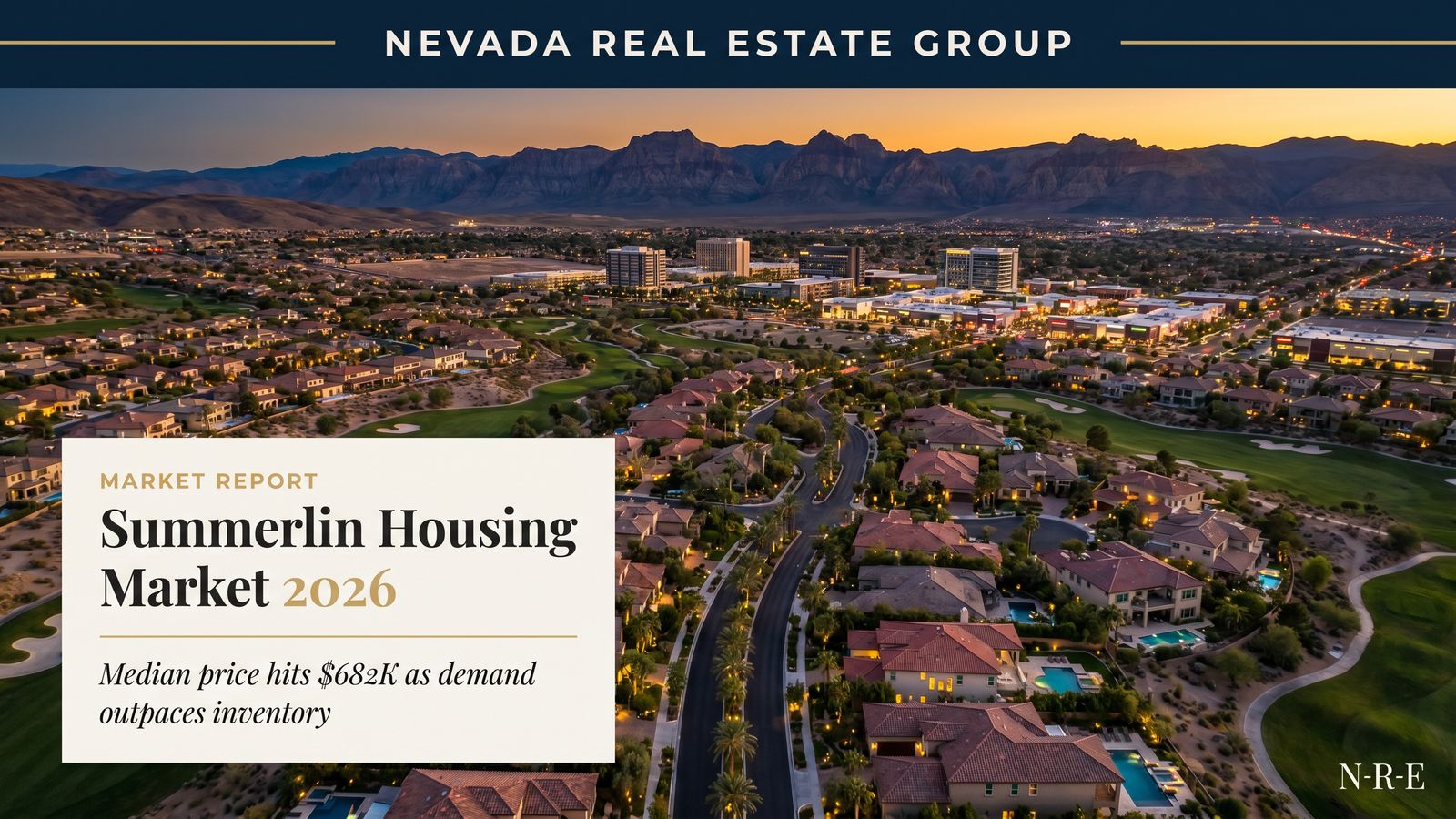
Summerlin sits at the top of the middle-market tier. The master plan covers 22,500 acres along the western edge of the valley adjacent to Red Rock Canyon. According to Howard Hughes Corporation, which controls development, Summerlin has been selling new home lots continuously since 1990. Villages like The Cliffs, Kestrel, and Redpoint carry premiums for Red Rock Canyon views and proximity to Downtown Summerlin. Expect to pay $550,000 to $900,000 for a detached single-family home in most Summerlin villages, with guard-gated enclaves like The Ridges reaching $2 million to $5 million-plus.
Henderson is one of the safest and most consistently appreciated cities in Nevada. According to U.S. Census Bureau QuickFacts, Henderson has a population over 340,000 and a median household income above $75,000 — both of which support strong housing demand. The Green Valley, Green Valley Ranch, and Inspirada master plans drive the $470,000 to $750,000 middle tier. The guard-gated hillside communities — MacDonald Highlands, Anthem Country Club, and Lake Las Vegas — push well above $1 million.
North Las Vegas is where first-time buyers and investors find the most attractive price-per-square-foot ratios in the metro. New construction in the Apex area and along the Highway 95 corridor has added thousands of homes priced between $340,000 and $430,000. According to the Bureau of Labor Statistics, North Las Vegas has seen some of the strongest job growth in the metro tied to warehouse and logistics expansion near the APEX industrial zone.

What Drives Las Vegas Home Prices?
Understanding what moves prices in this market helps you time your purchase and negotiate effectively.
Population growth: According to the U.S. Census Bureau, the Las Vegas-Henderson-Paradise MSA has grown by roughly 40,000 to 50,000 residents per year over the past five years, driven by California out-migration, remote-work relocations, and retirees seeking lower taxes. Every 50,000 new residents represent tens of thousands of potential homebuyers competing for limited inventory.
The lock-in effect: Thousands of Las Vegas homeowners refinanced into 3% mortgages in 2020 and 2021. They have no economic incentive to sell and take on a 6.5% replacement mortgage. This keeps resale inventory artificially constrained, which is why inventory gains in 2026 are coming primarily from new construction rather than existing homeowners.
No state income tax: Nevada has no state income tax — one of only nine states in the nation. According to the Nevada Department of Taxation, this is a permanent feature of the Nevada Constitution. For a household earning $150,000, the absence of a 13% California income tax (for example) means roughly $19,500 more in take-home pay per year. That extra cash flows directly into purchasing power, supporting home prices at every tier.
Employment base: According to the Bureau of Labor Statistics, the Las Vegas metro has approximately 1.1 million jobs. While gaming and hospitality remain the backbone, the tech, logistics, healthcare, and advanced manufacturing sectors have grown substantially. Companies like Switch, Amazon, Google, and Apple have built or expanded data centers and fulfillment infrastructure, diversifying the employment base that supports housing demand.
New construction supply: Clark County issued roughly 12,000 to 14,000 new residential permits in 2025, according to Clark County Department of Building. That sounds like a lot, but in a metro that added 45,000-plus new residents, it barely keeps pace. Major builders — Toll Brothers, KB Home, Lennar, Taylor Morrison, Woodside Homes — are all actively building in Summerlin, Henderson, and the northwest corridor.
Interest rate sensitivity: Like every market, Las Vegas home prices are sensitive to mortgage rates. The jump from 3% to 6.5% reduced purchasing power by roughly 30%, which is the primary reason prices softened from their 2022 peaks. According to Freddie Mac's Primary Mortgage Market Survey (PMMS), the 30-year fixed rate has been fluctuating between 6.2% and 7.1% in 2026, keeping some buyers on the sidelines and moderating price growth.
Where Are the Most Affordable Las Vegas Areas?
Not every buyer is chasing a guard-gated estate. For those focused on value, several corridors offer strong quality of life at a meaningful discount to the metro median.
North Las Vegas remains the most affordable major sub-market. The city of North Las Vegas covers roughly 100 square miles, much of it newer construction from 2005 through 2025. Neighborhoods around Aliante, Eldorado, and the Craig Road corridor offer detached single-family homes in the $330,000 to $420,000 range. According to Clark County Assessor data, property tax effective rates in North Las Vegas hover around 0.5% of market value — similar to the rest of the metro — so the lower purchase price directly translates to lower carrying costs.
Central and East Las Vegas offer the metro's lowest prices on a per-square-foot basis, particularly in areas like Whitney, Paradise, and the older zip codes near Nellis Boulevard. Many of these homes were built in the 1970s through 1990s and represent renovation opportunities in the $280,000 to $380,000 range.
Southwest Las Vegas fringe — including parts of Enterprise and unincorporated areas along Blue Diamond Road and the Las Vegas Beltway — have added new construction communities where buyers can get brand-new homes starting in the $380,000 to $440,000 range, occasionally with builder incentives that reduce the effective cost further.
In our experience at Nevada Real Estate Group, first-time buyers who are flexible on sub-market and willing to consider a 20-minute drive from the Strip can typically find 200- to 250-square-foot-per-dollar ratios at $320,000 to $380,000 — a better value proposition than anything currently available in Phoenix, Austin, or Boise at comparable price points.
Where Is Las Vegas Luxury Housing Concentrated?
The top tier of the Las Vegas market is anchored by a handful of highly defined enclaves. Knowing where luxury concentrates helps buyers understand why certain addresses command the prices they do.
The Ridges (Summerlin): The most prestigious address in Summerlin, The Ridges is a guard-gated village where custom homes and production estates range from $2 million to $15 million-plus. Red Rock Canyon is literally the backyard for residents along the western perimeter. According to Las Vegas REALTORS, The Ridges routinely produces some of the highest per-square-foot sale prices in Nevada.
MacDonald Highlands (Henderson): Situated on the southeast Henderson hillside with sweeping Strip and valley views, MacDonald Highlands is home to Dragon Ridge Country Club. Homes range from approximately $1.5 million to over $10 million for custom estates. The community is favored by executives, entertainers, and out-of-state buyers who want a trophy property in a warm climate.
The Summit Club: Las Vegas's most exclusive private residential club, The Summit Club is co-developed by Discovery Land Company and Howard Hughes Corporation. Lot prices alone have reached $2 million to $5 million; finished homes often clear $10 million to $25 million. Membership in the private club is by invitation.
Lake Las Vegas: A master-planned lakeside resort community in Henderson, Lake Las Vegas surrounds a 320-acre man-made lake. Luxury properties here range from $700,000 for lake-view condos to $5 million-plus for waterfront estates. The community draws buyers who want a resort lifestyle without flying anywhere.
How Much Income Do You Need to Buy in Las Vegas?
The purchase price is only one input. What matters day-to-day is whether the monthly payment fits your budget.
At the $470,000 median with a 6.5% 30-year fixed mortgage and 10% down ($47,000), your principal and interest payment is approximately $2,670 per month. Add property tax at 0.55% ($2,585/year, or $216/month), homeowner's insurance (approximately $150/month), and a median HOA of $118/month, and your all-in payment lands near $3,150 to $3,200 per month.
According to HUD's standard debt-to-income (DTI) guidelines, housing costs should not exceed 31% of gross monthly income for most loan programs. At $3,200 per month, that implies a minimum gross monthly income of approximately $10,300, or roughly $124,000 per year. Most buyers also carry some existing debt (car, student loans), which reduces the income threshold further — lenders typically use a 43% back-end DTI ceiling, meaning your total monthly debt including housing should stay at or below 43% of gross monthly income.
According to the Mortgage Bankers Association (MBA), the average down payment for first-time buyers in the Mountain West region is approximately 7 to 10%, meaning many Las Vegas first-timers are putting $33,000 to $47,000 down on the median home. Down payment assistance programs through the Nevada Housing Division (NHD) and the Federal Home Loan Bank can help buyers who qualify.
For buyers targeting $400,000 (below the median), the income threshold drops to roughly $100,000 to $110,000 annually. At $550,000 (upper middle market), plan for $140,000 to $155,000 in household income to stay within conservative DTI limits.
How Does Las Vegas Affordability Compare to California?
One of the most common questions I get from clients relocating out of California is: "What does my dollar actually buy me here?" The comparison is striking.
| Factor | Las Vegas Metro | Los Angeles | San Diego | |
|---|---|---|---|---|
| Median home price | approx. $470,000 | approx. $850,000 | approx. $900,000 | |
| State income tax | None | Up to 13.3% | Up to 13.3% | |
| Effective property tax rate | 0.5%–0.6% | 1.1%–1.3% | 1.1%–1.3% | |
| Annual property tax at median | approx. $2,585 | approx. $9,350+ | approx. $9,900+ | |
| Primary residence tax cap | 3% annual increase cap | 2% (Prop 13) | 2% (Prop 13) |
According to the Nevada Department of Taxation, Nevada's property tax abatement law caps primary residence tax increases at 3% per year regardless of home value appreciation. California's Proposition 13 caps at 2%, but new buyers in California inherit the full assessed value at purchase — so the initial tax bill on an $850,000 Los Angeles home is approximately $9,350 to $10,000 per year, versus roughly $2,585 on the Las Vegas $470,000 median.
The combined advantage — lower purchase price, zero state income tax, and Nevada's property tax cap — means a household earning $120,000 in Las Vegas keeps substantially more of their income than the same household earning the same salary in California.
What Is the Current Las Vegas Housing Market Trend in 2026?
To understand where prices are going, you need to understand the supply and demand dynamic right now.
Inventory is rising: According to Las Vegas REALTORS, active inventory is up approximately 18% year-over-year. There are currently around 6,000 to 6,500 single-family homes on the market without accepted offers. For the first time since 2019, buyers have legitimate options. You are not forced to bid on the first house you see because it is the only one available.
Homes are sitting longer: The average days on market has extended to 55 to 65 days from the 20 to 30 days seen during the 2021 and 2022 frenzy. This slowdown gives buyers breathing room to schedule second showings and negotiate.
Balanced market dynamics: With roughly 4.3 months of housing supply, the Las Vegas market sits in balanced territory. Under 3 months is a seller's market; over 6 months is a buyer's market. At 4.3 months, slight buyer leverage exists, particularly in the $400,000 to $550,000 range where supply has increased the most.
New construction incentives: According to the Clark County Department of Building, builder activity remains strong with new permits up year-over-year. Builders including Toll Brothers, KB Home, Lennar, and Taylor Morrison are offering rate buy-downs of 1 to 2 full percentage points on 2-1 buy-down programs, effectively letting buyers access rates closer to 4.5% to 5.5% in the first two years. These incentives are reducing the effective cost of new construction relative to resale.
The Las Vegas housing market has historically rewarded buyers who purchased during periods of normalization rather than waiting for a crash that never arrives. The valley added roughly 45,000 residents in 2025 alone — demand is structural, not speculative.
What Are the True Monthly Costs of Owning a Las Vegas Home?
First-time buyers and transplants from California regularly underestimate or overestimate Las Vegas carrying costs. Here is the full picture.
Property taxes: Nevada applies the tax rate to the "taxable value," which is roughly 35% of market value, not the full assessed value. For a $470,000 home, the taxable value is approximately $164,500. The Clark County property tax rate for Clark County Unified School District, basic county, and special taxing districts combined is approximately 3.2837 per $100 of assessed value as of 2025-2026, per Clark County Assessor records. That works out to roughly $5,400 per year on the taxable value, but after the Nevada Revised Statutes abatement — which caps primary residence tax increases at 3% per year — many established owners pay effective rates well below that on appreciated homes. New buyers will pay closer to $2,300 to $2,800 per year in the first year on a $470,000 purchase.
HOA fees: The median HOA fee in the Las Vegas metro is approximately $118 per month, but actual fees vary enormously. Non-gated subdivisions with basic common area maintenance: $30 to $80 per month. Gated communities with pools and guard houses: $150 to $350 per month. Master-planned communities like Summerlin carry a master fee of approximately $37 to $76 per month plus a sub-association fee of $50 to $250 per month — meaning some Summerlin buyers pay $80 to $330 per month in HOA fees before insurance and taxes.
Special Improvement Districts (SIDs) and LIDs: These are infrastructure bonds attached to newer homes to pay off roads, sewers, and utilities. On new construction or recently built homes, SID/LID payments can add $40 to $120 per month to the total carrying cost. Always ask about SIDs and LIDs before writing an offer on a newer Las Vegas home.
Homeowner's insurance: Nevada has lower homeowner's insurance rates than most coastal and tornado-prone states. Expect $900 to $1,800 per year for a standard $470,000 Las Vegas home, depending on coverage and provider.
Utilities: The desert climate means air conditioning runs hard from May through October. NV Energy bills for a typical 2,000-square-foot home average $150 to $250 per month in summer and $60 to $100 in winter. Water rates from the Las Vegas Valley Water District are higher per gallon than many states due to water scarcity, but typical household monthly bills run $50 to $90.
Will Las Vegas Home Prices Drop in 2026 or Rise?
The question every buyer asks: "Should I wait for a crash?"
The consensus from market data: Most analysis points to stability with modest variation — flat to plus or minus 3% for the balance of 2026. According to FHFA, Las Vegas was among the MSAs that saw below-average price appreciation in 2024 and early 2025, meaning the most overheated gains have already corrected. The market is not poised for a sharp drop because the structural factors supporting demand — population growth, no income tax, job diversification — remain intact.
What could push prices higher: If mortgage rates decline from the 6.5% to 7% range toward 5.5% to 6%, pent-up demand from buyers who have been waiting on the sidelines would accelerate purchases, tightening inventory and pushing prices up 3 to 5% in the near term.
What could push prices lower: A significant national recession, a sharp reversal in employment, or a sudden flood of resale inventory from distressed sellers would all soften prices. None of these scenarios is currently indicated by local economic data, but all are possible tail risks.
My perspective: Across 16-plus years and 9,600-plus closings at Nevada Real Estate Group, I have watched Las Vegas absorb multiple economic shocks — 2008 to 2012 collapse, 2020 pandemic shutdown, and the 2022 rate spike. Each time, the market stabilized faster than analysts predicted. Buyers who purchased during periods of uncertainty — 2012, 2014, 2019, 2020 — have seen extraordinary returns. I cannot promise 2026 will follow that pattern, but the structural demand is the strongest I have seen outside the pandemic peak.
Explore the full cost of living in Las Vegas breakdown, which pairs home price data with utilities, healthcare, and transportation costs to give you a complete relocation budget picture.
For a side-by-side look at average rental costs if you're not yet ready to buy, see our average rent in Las Vegas guide.
How Can NREG Help You Buy or Sell in Las Vegas?
Nevada Real Estate Group is the number-one real estate team in Nevada and number-44 nationally. I personally have represented more than 5,000 closings across the Las Vegas metro, and my team of 150-plus licensed agents covers every sub-market from Summerlin to North Las Vegas to Henderson guard-gated hillside communities.
When you work with NREG, you get:
- Access to off-market and pre-market listings before they hit public search sites
- In-house transaction management from offer through close
- Builder relationships that can unlock incentives not publicly advertised
- Negotiation experience from 9,600-plus closed transactions and $4.85 billion-plus in total sales volume
Call (702) 637-1759 or visit our office at 8945 W Russell Rd, Suite 170, Las Vegas, NV 89148 to schedule a buyer consultation at no cost.
Frequently Asked Questions About Las Vegas Home Prices
What is the average home price in Las Vegas in 2026?
The median single-family home sale price in the Las Vegas metro is approximately $470,000 in mid-2026, according to Las Vegas REALTORS. The mean (average) is higher — closer to $618,000 to $650,000 — because luxury sales above $1 million pull the number up. For budget planning, use the median. The average reflects what the market includes, not what the typical buyer pays.
Are Las Vegas home prices dropping in 2026?
Prices are down approximately 1 to 3% year-over-year from the 2022 peak highs, according to FHFA data for the Las Vegas-Henderson-Paradise MSA. This is a normalization, not a crash. Inventory is rising and days on market are extending, which gives buyers more leverage than they had during the 2020 to 2022 frenzy, but fundamental demand — driven by population growth and no state income tax — continues to underpin prices.
What salary do you need to afford a house in Las Vegas?
To comfortably afford the $470,000 median with a 10% down payment and 6.5% rate, most lenders require a household income between $110,000 and $125,000. If you are putting 20% down ($94,000), the income threshold drops to roughly $95,000 to $110,000 annually. For homes at $380,000 to $420,000, $90,000 to $100,000 in household income is typically sufficient.
What is the most affordable area in Las Vegas to buy a home?
North Las Vegas offers the lowest median prices in the metro, with many detached single-family homes available in the $330,000 to $420,000 range. Central Las Vegas neighborhoods east of I-15 and near Nellis Boulevard also carry below-median pricing. These areas trade location premium for price — buyers get more square footage and newer construction for their dollar compared to Summerlin or Henderson.
How much are HOA fees in Las Vegas?
The Las Vegas metro median HOA fee is approximately $118 per month for a single-layer association. Master-planned communities like Summerlin carry dual-layer fees — a master plan fee ($37 to $76/month) plus a sub-association fee ($50 to $250/month) — totaling $87 to $326 per month. High-rise condos near the Strip can carry HOA fees of $300 to $600 per month. Always request the HOA disclosure package before writing an offer.
Is Las Vegas real estate a good investment in 2026?
Las Vegas has historically been a strong long-term real estate market. The combination of above-average population growth, no state income tax, a diversifying employment base, and constrained land supply creates durable demand. According to FHFA, Las Vegas appreciated faster than the national average in 7 of the 10 years between 2013 and 2023. The 2022 to 2025 cooling period has reset expectations to sustainable levels, which is generally a healthier starting point for new buyers.
What are typical closing costs when buying in Las Vegas?
Buyers in Nevada typically pay 2% to 4% of the purchase price in closing costs. On a $470,000 purchase, that is roughly $9,400 to $18,800. Major line items include lender origination fees ($1,500 to $3,500), title insurance ($1,200 to $2,500), escrow fees ($800 to $1,500), prepaid property taxes (3 to 6 months), and prepaid homeowner's insurance. Nevada does not have a transfer tax on residential sales paid by the buyer — sellers pay the deed transfer tax (currently $1.95 per $500 of value).
Which Sources Inform This Las Vegas Home Price Guide?
Prices and statistics cited in this guide reflect publicly available data from Las Vegas REALTORS (LVR), FHFA, Census Bureau, and other listed authorities as of Q1–Q2 2026. Real estate markets change; verify current figures with a licensed NREG agent before making purchase decisions.
- Las Vegas REALTORS (LVR) — Monthly Statistics Report
- Federal Housing Finance Agency (FHFA) — House Price Index
- U.S. Census Bureau — QuickFacts: Las Vegas metro
- Clark County Assessor — Property Tax Information
- Freddie Mac Primary Mortgage Market Survey (PMMS)
- Bureau of Labor Statistics — Las Vegas-Henderson-Paradise MSA Employment
- U.S. Department of Housing and Urban Development (HUD) — Affordability Guidelines
- Nevada Department of Taxation — Property Tax Abatement Summary
- National Association of Realtors — Existing-Home Sales Data
- Mortgage Bankers Association — Loan Application Survey