
Published March 5, 2026 · Updated June 16, 2026 · By Chris Nevada, Nevada Real Estate Group · NV License S.181401
Nevada has a well-deserved reputation as a tax-friendly state — no state income tax, no inheritance tax, and property taxes that run well below the national average. Yet the question I hear most from buyers sitting across from me at the closing table is not about income tax at all. It is: "What am I actually going to pay in property taxes every month?" For a full 2026 walkthrough of the assessed-value formula, the 3% cap, and new-construction reassessment, see our companion guide, Las Vegas property taxes explained for 2026.
For a $450,000 home in Clark County, the answer is typically somewhere between $2,000 and $2,700 per year — or roughly $170 to $225 per month rolled into your mortgage escrow. That is a fraction of what the same home would cost in California, Oregon, or Texas. The key to that favorable number is Nevada's two-part formula: a 35% assessment ratio that shrinks the taxable base, and a statutory 3% annual cap that prevents your bill from spiking even when home values surge.
Across the 9,600-plus closings Nevada Real Estate Group — the #1 real estate team in Nevada — has helped clients close, property taxes are consistently one of the most misunderstood line items in a buyer's budget. This guide covers how the bill is calculated, what protects you from increases, which exemptions can lower your bill further, and exactly when to write the check.
Las Vegas (Clark County) property taxes apply a 3.10% district rate to 35% of your home's taxable value — effectively 0.5%–0.75% of market price. A $450,000 home typically owes $1,900–$2,700 per year. Nevada caps annual increases at 3% for owner-occupied primary residences under NRS 361.4722. Call (702) 637-1759 for a parcel-specific estimate.
- Clark County assesses at 35% of taxable value — a $450,000 home has roughly $120,750 assessed value before the rate applies.
- Primary-residence owners are capped at 3% annual tax increases under NRS 361.4722 — investment properties face up to 8%.
- Tax rates range from 2.90% (Henderson) to 3.27% (City of Las Vegas) of assessed value by district.
- New-build buyers pay taxes on land only in year one; the full improvement bill arrives after the Assessor inspects.
- Veterans, surviving spouses, and legally blind residents can apply for exemptions that reduce the taxable base directly.
How Are Las Vegas Property Taxes Calculated?
Understanding the Las Vegas property tax formula requires separating three terms that most people use interchangeably but mean very different things: market value, taxable value, and assessed value. In my experience sitting across the table from buyers at Las Vegas closings, this distinction is the single most common source of tax-bill shock — and the easiest one to pre-empt with a five-minute explanation.
Market value is what buyers are currently paying for comparable homes — the number you see on listing portals. The Clark County Assessor does not use this number directly.
Taxable value is what the Assessor calculates using a cost-replacement model: land value plus the replacement cost of the improvements (the house), minus depreciation at 1.5% per year up to a maximum of 50 years. Because depreciation is subtracted and replacement costs tend to lag behind market appreciation in a hot market, the taxable value is usually meaningfully below the market price you paid.
Assessed value is 35% of taxable value. This is the number the tax rate is applied to. According to the Clark County Assessor, the 35% ratio is fixed in Nevada statute and applies uniformly across all residential property in the state.
Finally, the abatement is applied: the tax bill cannot exceed the previous year's bill by more than 3% for a primary residence (or 8% for non-owner-occupied property). If the calculated bill is higher, it gets capped.
| Step | Formula / Rule | Example: $450,000 Home |
|---|---|---|
| 1. Land Value | Assessor appraises lot at market rate | $90,000 |
| 2. Improvement Value | Replacement cost minus depreciation (1.5%/yr) | $300,000 (age 10 = $255,000) |
| 3. Taxable Value | Land + Depreciated Improvements | $345,000 |
| 4. Assessed Value | Taxable Value × 35% | $120,750 |
| 5. Gross Tax | Assessed Value × District Rate (3.10%) | $3,743 |
| 6. Abatement Applied | Cap to 3% above prior year bill (primary residence) | May reduce to approx. $2,100–$2,400 in practice |
| 7. Annual Bill | Post-abatement amount due | Approx. $2,100–$2,400 |
According to the Nevada Department of Taxation, the assessed value is intended to represent 35% of the property's full cash value at the time of assessment — a constitutional requirement that ensures uniformity across all counties in the state.
What Is the Clark County Property Tax Rate in 2026?
Your exact tax rate depends on which Tax Rate Area (TRA) your parcel falls in. Clark County is divided into dozens of TRAs, each reflecting a different combination of overlapping taxing entities — the county, the municipality, school districts, water districts, and other special districts.
According to the Clark County Assessor's TRA lookup, most residential properties in the Las Vegas Valley fall within a band of 2.75% to 3.40% of assessed value. Whether you are comparing a home in Henderson versus one in the unincorporated county, your agent should pull the specific TRA rate from the parcel report before you submit an offer. Here is a breakdown of the most common areas:
- City of Las Vegas (incorporated): approximately 3.27%
- City of Henderson: approximately 2.90%–3.05%
- City of North Las Vegas: approximately 3.10%–3.25%
- Unincorporated Clark County (Las Vegas Strip corridor, Summerlin, Enterprise, Spring Valley): approximately 2.90%–3.40%
Remember: these rates apply to the assessed value (35% of taxable value), not the purchase price. So a 3.10% rate on a home with a $120,750 assessed value produces a $3,743 gross bill — before the abatement cap brings it down to the actual amount due.
For any specific parcel, the most accurate step is to pull the Assessor's parcel report at Clark County's online search, which shows your TRA, assessed value, and current year bill simultaneously.
What Is the Nevada Property Tax Abatement Cap?
The abatement cap is Nevada's most buyer-friendly property tax provision, and it is the reason Las Vegas homeowners do not face the sudden five-figure tax spikes common in California, Texas, or Florida after a hot market year.
According to Nevada Revised Statutes Chapter 361, specifically NRS 361.4722, the abatement works as follows:
- Primary residences (owner-occupied): The property tax bill cannot increase by more than 3% per year from the prior year's bill, regardless of how much the assessed value rose.
- All other property (investment, commercial, vacant land, second homes): The cap is higher — up to 8% per year, with the exact cap tied to the 10-year average change in assessed values across the county.
The abatement applies to the tax amount, not to assessed value. The Assessor still reappraises annually; the cap simply prevents the resulting bill from growing faster than the defined ceiling.
What this means for buyers: When you purchase a home, you inherit the prior owner's capped basis. If the previous owner benefited from years of 3% caps while the market soared, there may be a significant gap between what they paid and what the uncapped bill would be. Your first-year bill resets to the full calculated amount — which is often a meaningful jump. According to the Clark County Assessor, this "reset on sale" is the most common reason new owners see a higher tax bill than the seller disclosed.
What Exemptions Can Lower Your Las Vegas Property Tax?
Nevada offers several statutory exemptions that reduce the assessed value used to calculate your bill. These exemptions are not automatic — you must apply at the Clark County Assessor's office, and they must be renewed annually in most cases. I remind every veteran buyer I work with — whether they are buying in Henderson, Summerlin, or North Las Vegas — to file these applications before the June 15 deadline, because many simply never knew they were available.

| Exemption | Who Qualifies | Assessed Value Reduction | Annual Savings (est. at 3.10% rate) |
|---|---|---|---|
| Veteran's Exemption — Non-Disabled | Honorably discharged veterans who served during qualifying war periods | $2,000 off assessed value | Approx. $62/year |
| Veteran's Exemption — Disabled (10–100%) | Veterans with VA disability rating of 10% or more | $2,000–$20,000+ off assessed value (scales with rating) | Approx. $62–$620+/year |
| Surviving Spouse of Veteran | Unremarried surviving spouse of a qualifying veteran | Same as veteran's base exemption | Approx. $62/year |
| Blind Person Exemption | Residents who meet Nevada's definition of legal blindness | $3,000 off assessed value | Approx. $93/year |
| Low-Income Senior Assistance | Seniors meeting income thresholds (varies by year) | Varies; may freeze assessed value | Varies significantly |
| Homestead Protection | Primary residence owners (all) — not a tax exemption but protects equity from creditors | N/A — equity protection, not tax reduction | N/A |
According to the Clark County Assessor's exemption portal, applications must be filed by June 15 each year for the exemption to apply to the following fiscal year's bill. Veterans can bring their DD-214; disability claims require VA documentation.
There is no blanket senior property tax exemption in Nevada based solely on age. The low-income senior assistance program is means-tested, and eligibility thresholds are updated annually by the state legislature. If you or a family member may qualify, call our office at (702) 637-1759 and we will point you directly to the current application.
How Do Las Vegas Property Taxes Compare to California and Other States?
Nevada's property tax structure looks dramatically favorable when placed alongside high-tax states — which is one of the primary financial drivers behind California-to-Las Vegas migration. It is a topic I cover in depth when talking with relocating families who are weighing the full cost of living in Summerlin versus staying in Orange County or the Bay Area. According to the U.S. Census Bureau QuickFacts, Nevada's effective median property tax rate is approximately 0.55% of home value, compared to 0.75% for California and well over 1.5% for Texas, Illinois, and New Jersey.
| Metric | Nevada (Clark County) | California | Texas | Arizona |
|---|---|---|---|---|
| Effective Rate (% of market value) | 0.50%–0.75% | 0.70%–0.75% | 1.60%–2.00% | 0.55%–0.65% |
| Annual Bill on $600K Home | $3,000–$4,500 | $4,200–$4,500 | $9,600–$12,000 | $3,300–$3,900 |
| Annual Increase Cap | 3% (primary) / 8% (other) | 2% under Prop 13 | 10% (homestead) | 5% (limited) |
| State Income Tax | None | 1%–13.3% | None | 2.5% flat |
| Reset on Sale? | Yes — full calc on purchase year | Yes — full reset under Prop 13 | Partial; protest common | Yes |
| Assessment Ratio | 35% of taxable value | 100% of purchase price | 100% of market value | 10% of full cash value |
California's Proposition 13 provides a 2% annual cap similar to Nevada's 3% cap — but California's base effective rate starts higher, and California adds a 1%–13.3% state income tax that makes the combined tax burden dramatically higher than Nevada's. For a California household earning $200,000 and owning a $700,000 home, moving to the Las Vegas area typically saves $15,000–$25,000+ per year in combined income and property taxes.
When Are Clark County Property Taxes Due?
According to the Clark County Treasurer, Nevada operates on a July 1–June 30 fiscal year. Homeowners can pay in full or in installments. There are two main options:
Option 1 — Pay in Full (with discount): Pay the entire annual bill by August 16 and receive a 2% discount on the county and school district portion of the tax.
Option 2 — Four Installments:
- 1st installment: Due on or before the 3rd Monday of August (approximately August 18, 2025 for the 2025–2026 tax year)
- 2nd installment: Due on or before the 1st Monday of October (approximately October 6, 2025)
- 3rd installment: Due on or before the 1st Monday of January (approximately January 5, 2026)
- 4th installment: Due on or before the 1st Monday of March (approximately March 2, 2026)
There is a 10-day grace period after each due date. Miss the grace period and a 4% penalty applies immediately; it escalates further the longer the bill stays unpaid. If you have a mortgage, your lender handles this through your escrow account — but verify the payment was made by looking up your parcel on the Clark County Treasurer's website at least once a year.
How Do Property Taxes Affect Your Monthly Mortgage Payment?
Most Las Vegas buyers finance their property taxes through an escrow account managed by their lender. The lender estimates the annual property tax bill, divides by 12, and adds that amount to your monthly payment alongside principal, interest, and homeowner's insurance. This is especially important for first-time buyers who may not have budgeted for escrow adjustments in year two.
For a $450,000 home with an estimated annual tax bill of $2,300:
- Monthly escrow tax contribution: approximately $192
- Added to a 30-year mortgage at 6.85% on a $360,000 loan (20% down): approximately $2,362 principal + interest
- Total PITI payment: approximately $2,554 per month
According to the Freddie Mac Primary Mortgage Market Survey, national average 30-year fixed rates have fluctuated between 6.5% and 7.2% in the first half of 2026 — always factor the current rate into your PITI calculation before committing to a price range.
Two things can push your escrow tax portion up: a post-sale reassessment (the first full-year bill after you buy may be higher than the seller's prior bill due to the abatement reset) and increases in your TRA's tax rate when local bond measures pass. Your lender will re-estimate escrow annually and adjust your payment accordingly.
How Can You Appeal Your Clark County Assessment?
If you believe the Clark County Assessor has overvalued your property, you have the right to appeal. According to Nevada Revised Statutes Chapter 361, the appeal process involves two levels:
Step 1 — Informal Appeal to the Assessor: Contact the Clark County Assessor's office directly, typically between January and the end of February each year (check the Assessor's office for exact current-year deadlines). Bring comparable sales data showing that similar homes sold for less than your assessed taxable value implies.
Step 2 — County Board of Equalization: If the informal appeal is denied, you can file with the Nevada Tax Commission's County Board of Equalization. Hearings are scheduled in March and April. You will need to present evidence — recent comparable sales, an independent appraisal, or documentation of property condition issues that affect value.
Step 3 — State Board of Equalization: If the County Board denies your appeal, you can escalate to the State Board of Equalization, then ultimately to the District Court.
In practice, the most successful appeals involve either factual errors (wrong square footage, incorrect bedroom count, a structure that was demolished) or compelling comparable sales evidence showing the Assessor's taxable value is materially above what similar properties actually sold for. According to the Nevada Department of Taxation, approximately 15–20% of residential appeals result in a reduction each year. I have seen clients in Henderson and Summerlin save $400–$900 per year after a successful appeal — it is worth the afternoon of preparation if the Assessor's value is clearly above the market evidence.
What Should New Construction Buyers Know About Property Taxes in Las Vegas?
New construction property tax treatment in Clark County has a specific quirk that surprises many first-time new construction buyers: you pay taxes on the land only until the improvements are assessed.
Here is how it works:
- You close on a new construction home in, say, October 2025.
- For the current fiscal year (through June 30, 2026), the Assessor may only have assessed the land parcel — because the house did not exist or was not completed at the January 1 assessment date.
- Your first-year tax bill may be very low — sometimes as little as $300–$600 if only the bare lot is assessed.
- After the Assessor inspects the completed home, the full improvement value is added. Your second-year bill reflects both land and improvements — and this is when the abatement reset also applies.
According to our dedicated guide on property tax reassessment for new construction, some builders actually use the low first-year tax as a marketing talking point — citing the temporary low figure as if it represents ongoing costs. It does not. Budget for the full tax bill starting in year two.
Additionally, the 3% abatement cap does not apply in your first year of ownership because there is no prior-year baseline to cap against. The full calculated bill is due from the first full assessment year forward.
How Do Property Taxes Differ Across Las Vegas Communities?
While Clark County applies a uniform 35% assessment ratio, the tax rate you pay varies based on your Tax Rate Area — the combination of overlapping jurisdictions that provide services to your parcel. If you are evaluating communities in the Las Vegas area and want to compare tax districts side by side before committing to a neighborhood, this is one of the first data points I pull for every buyer consultation.
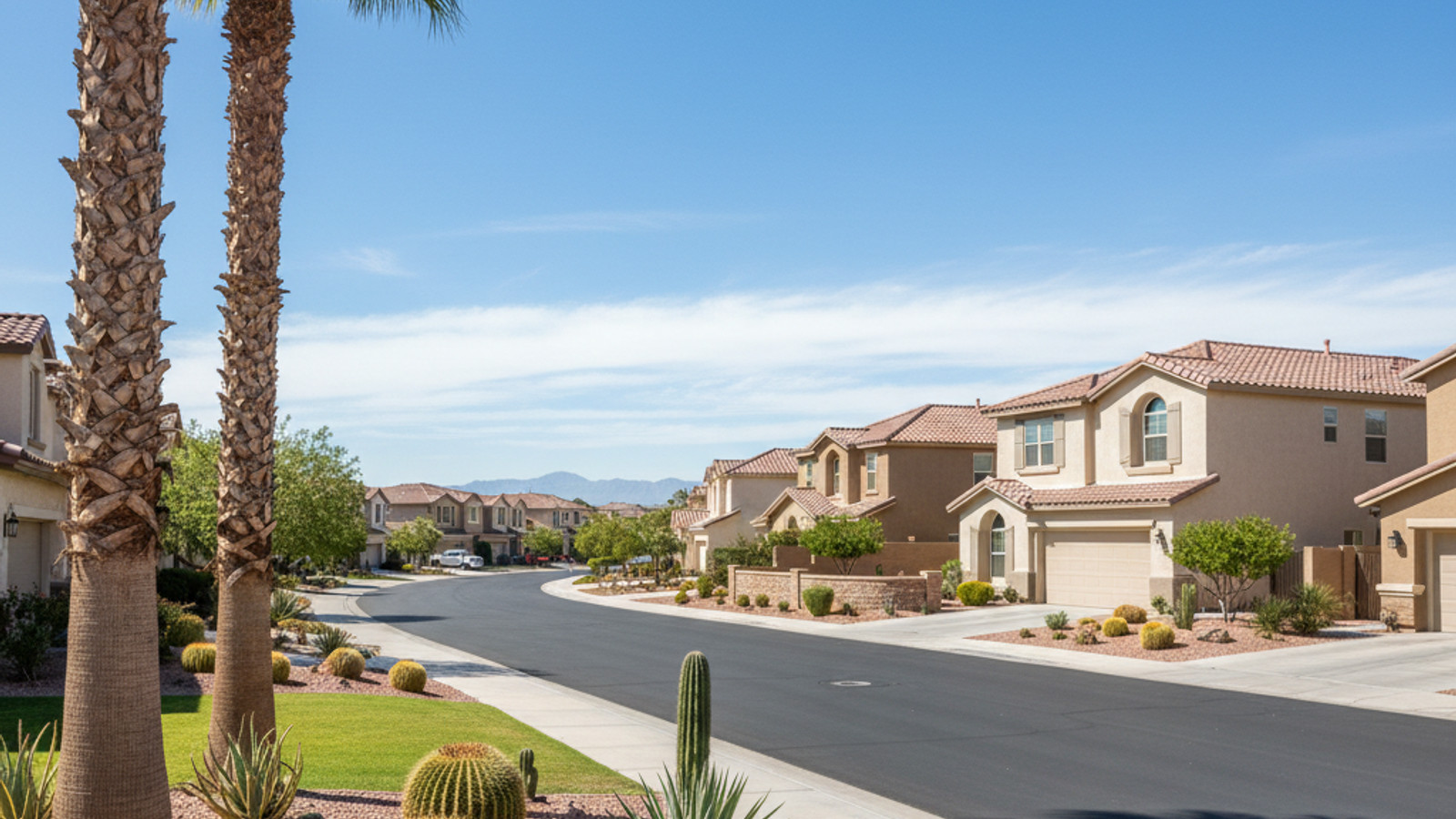
Here is how the major Las Vegas Valley communities compare:
- Summerlin (unincorporated Clark County): Rates typically range from 3.00% to 3.27% of assessed value. Summerlin community association fees are separate from property taxes and can add $75–$300+ per month depending on the village.
- Henderson: City of Henderson rates generally run 2.90%–3.05%, slightly below Las Vegas proper. Henderson's mix of master-planned communities like Anthem, Cadence, and MacDonald Highlands makes it one of the most popular relocation destinations in the valley.
- North Las Vegas: Rates are comparable to City of Las Vegas — approximately 3.10%–3.25%. North Las Vegas has seen significant new master-plan development in recent years, attracting first-time buyers with lower price points.
- Las Vegas Valley (unincorporated): The broad swath of the valley not inside any incorporated city (Spring Valley, Enterprise, Whitney, Sunrise Manor) falls under Clark County's unincorporated TRAs, typically 2.90%–3.40%.
- Boulder City: Has its own charter and municipal structure; rates differ from Clark County's standard range.
According to the Las Vegas REALTORS market reports, community-level tax differences are rarely a dominant factor in buyer decisions compared to price, commute, and school quality — but for luxury purchases above $1.5 million, the difference between a 2.90% and 3.27% TRA on a $525,000+ assessed value can represent $1,900+ per year.
What Are the Property Tax Implications for Investors and Rental Properties?
If you are buying an investment property, a second home, or a short-term rental in the Las Vegas area, the property tax structure is less favorable than for owner-occupants — but still among the best in the nation for investors. Many of the buyers I work with through Nevada Real Estate Group are California-based investors attracted specifically by the tax differential.
Key differences for non-owner-occupied property:
- Higher abatement cap: Investment and rental properties are subject to the 8% annual cap rather than the 3% cap. In a hot market, this means your tax bill could effectively triple over a decade while an owner-occupant next door sees only a 34% cumulative increase (3% compounded for 10 years). Browse guard-gated communities and luxury communities to see how the tax math plays out on higher-priced investment assets.
- No primary residence exemptions: Veterans, surviving spouse, and other personal exemptions are available only on a primary residence.
- Short-term rental (Airbnb / VRBO): Clark County may reclassify short-term rental properties as commercial, potentially altering the assessed value methodology. Always consult a local tax professional before launching an STR operation.
- Depreciation for federal purposes: While Nevada has no income tax, the federal deductibility of property taxes is capped at $10,000 for all state and local taxes combined (SALT cap) under current IRS rules. According to the IRS Topic No. 503, investment property taxes remain fully deductible against rental income at the federal level when reported on Schedule E.
For investors comparing Nevada to California for rental portfolio expansion, the combination of lower effective property tax rates and zero state income tax on rental income makes Nevada — particularly Las Vegas, Henderson, and North Las Vegas — one of the most landlord-friendly major metro areas in the United States.
Should You Budget for Property Tax Increases When Buying in Las Vegas?
In short: yes, but within predictable bounds.
Nevada's 3% primary residence cap gives you a clear ceiling for annual growth. If your first-year bill is $2,200, the maximum it can reach in year ten — with the cap triggered every single year — is approximately $2,956 (3% compounded for 10 years). That is an additional $756 per year over a decade, or about $63 per month.
Two scenarios can produce larger increases:
- You buy a home where the seller benefited from years of caps: The abatement resets on sale, so your first-year bill reflects the full current-year calculation — which may be significantly higher than what the seller paid. This is especially relevant for buyers moving to Las Vegas from out of state who have no prior frame of reference.
- Your TRA passes new bond measures: Local school bonds, water district improvements, and infrastructure bonds can increase the tax rate within your TRA. These are voted on by local residents and are disclosed in the property report.
According to the Nevada Legislature, any new TRA tax rate increase requires a two-thirds vote of the appropriate governing body or voter approval for bond measures — adding a democratic check on rate growth that many other states lack.
Practical budgeting advice: When reviewing a property, ask your agent to pull the Assessor's parcel report and calculate the post-sale first-year bill from scratch — do not rely on the seller's current tax bill. Also build a 3% annual escalator into your 5-year and 10-year housing cost projections. In my experience, buyers who ignore this step and anchor to the seller's artificially low capped bill end up surprised at their second-year escrow adjustment. If you would like a full buyer's worksheet tailored to a specific property — in Las Vegas, Henderson, or anywhere in Clark County — call (702) 637-1759 and a Nevada Real Estate Group advisor will run the numbers with you.
Frequently Asked Questions About Las Vegas Property Taxes
What is the effective property tax rate in Las Vegas?
The effective property tax rate for most Las Vegas Valley homeowners falls between 0.50% and 0.75% of market value, which is well below the national average of approximately 1.1%. According to the U.S. Census Bureau, Nevada's median effective rate is approximately 0.55%. The rate feels lower than the nominal 2.75%–3.27% district rates because those apply only to 35% of taxable value — not the full purchase price.
What is Nevada's 3% tax abatement cap and how do I qualify?
Under NRS 361.4722, the property tax bill on an owner-occupied primary residence cannot increase by more than 3% per year over the prior year's bill, regardless of assessed value changes. You qualify automatically as long as the property is your primary residence and you have filed the primary residence declaration with the Clark County Assessor. You must re-file if you move or convert the property to a rental.
Do Las Vegas property taxes reset when I buy a home?
Yes. When a property changes ownership, the abatement baseline resets. The new owner's first-year bill is calculated on the current full taxable value without the cap benefit the seller accumulated. This is the single most common cause of tax bill surprises for new Las Vegas homeowners — always ask for a fresh calculation before you close.
How do I look up my Clark County property tax bill?
Visit the Clark County Treasurer's website and search by your property address or Assessor's Parcel Number (APN). Your APN appears on your deed, your title report, and all Assessor correspondence. The site shows your current bill, payment history, and any outstanding balance.
When are Clark County property taxes due in 2026?
For the 2025–2026 tax year, the four installment due dates fall approximately in August 2025, October 2025, January 2026, and March 2026. You can pay the full amount by mid-August for a small discount. A 10-day grace period applies after each installment due date; penalties begin at 4% after the grace period expires.
Can I deduct Las Vegas property taxes on my federal return?
Yes, but the SALT (state and local tax) deduction is currently capped at $10,000 per year for individuals and married-filing-jointly filers under federal law. If you itemize deductions, your Clark County property tax payment counts toward that $10,000 combined SALT cap. According to the IRS, investment property taxes are fully deductible against rental income on Schedule E without the SALT cap limitation.
Are there property tax breaks for seniors in Las Vegas?
Nevada does not have a blanket senior property tax exemption based on age alone. Seniors may qualify for veterans' exemptions (if applicable), the blind persons' exemption, or means-tested low-income senior assistance programs administered by the Assessor. According to the Nevada Legislature, low-income senior assistance program thresholds are updated annually; check with the Clark County Assessor directly for the current qualifying income limits.
Which Sources Inform This Las Vegas Property Tax Guide?
This guide draws on direct experience from 9,600-plus closings across the Las Vegas metro and the following authoritative public sources for all rate, statute, and deadline information.
- Clark County Assessor — assessment methodology, taxable vs. assessed value, exemption applications, TRA lookup
- Nevada Department of Taxation — statewide property tax administration, assessment ratio statutes, appeal procedures
- NRS Chapter 361 – Property Tax — abatement caps (NRS 361.4722), assessment ratios, appeal rights, full statutory text
- Clark County Treasurer — installment due dates, payment options, penalty schedule, parcel search
- U.S. Census Bureau QuickFacts – Nevada — comparative effective tax rate data, demographic and housing data
- Las Vegas REALTORS Market Reports — median home prices, transaction volume, community-level data
- Nevada Legislature – Session Laws — bond measure requirements, tax district governance, TRA rate change procedures
- IRS – Real Estate Taxes (Topic 503) — SALT deduction cap, Schedule E investment property deductibility
- Freddie Mac Primary Mortgage Market Survey — current 30-year fixed rates for PITI estimates
- HUD – Affordable Housing and Homebuyer Resources — first-time buyer guidance, escrow account requirements
- NAR – State-by-State Property Tax Data — national comparisons, property tax burden rankings
This guide provides general information only and is not tax or legal advice. Assessed values, rates, and due dates change each fiscal year. Verify your specific parcel's assessed value, TRA rate, and current bill with the Clark County Assessor's Office and Treasurer before closing.