
Las Vegas Property Taxes Explained: How Clark County Calculates Your Bill and 3 Exemptions That Lower It
If you own a home in Las Vegas, Henderson, or anywhere in Clark County, your property tax bill is one of the most predictable — and most reducible — costs of homeownership. But most people never look past the number on the bill. I’m Chris Nevada with the Nevada Real Estate Group, and I walk clients through this every week. Here’s exactly how it works in 2026. For the complete reference on rates, the 3% primary-residence cap, and the full assessment math, see our main Las Vegas property taxes guide; this article zooms in on the exemptions that lower your bill.
How Clark County Calculates Your Property Tax
Nevada uses a simple formula: the county assessor sets your home’s taxable value, then multiplies it by an assessment ratio of 35% to arrive at your assessed value. That assessed value is then multiplied by the tax rate for your specific jurisdiction.
For example, if your home’s taxable value is $400,000, the assessed value is $140,000 (35% of $400,000). Multiply that by a typical Clark County combined tax rate and you get your annual property tax bill. The exact rate varies slightly depending on whether you’re in the City of Las Vegas, Henderson, North Las Vegas, or unincorporated Clark County.
What makes Nevada stand out is the tax abatement cap. For owner-occupied primary residences, the state limits how much your assessed value can increase each year. This protects long-term homeowners from sharp spikes during periods of rapid price appreciation — something Las Vegas has seen plenty of since 2020.
The Abatement Reset: What Buyers Need to Know
Here’s where most buyers get surprised. When you purchase a home, the abatement cap resets to the new purchase price. That means if the seller was a long-term owner paying taxes on a much lower assessed value, your first-year tax bill could be significantly higher than what they were paying.
This is especially common in Summerlin, Henderson, and the southwest valley where home values have climbed steadily. I tell every buyer: budget your property taxes based on your purchase price, not the seller’s tax history. The seller’s number is irrelevant to what you’ll owe.
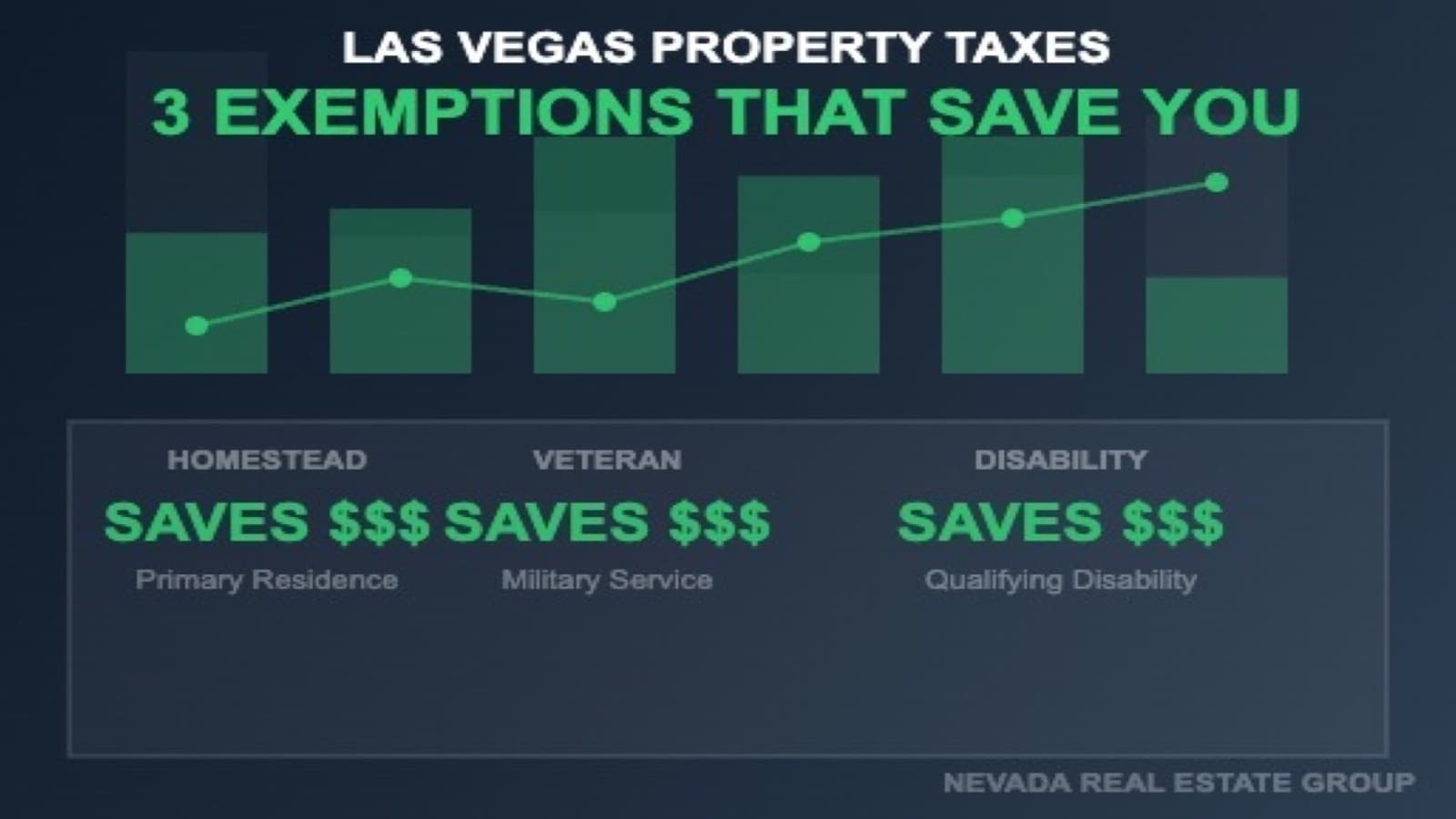
3 Exemptions That Can Lower Your Tax Bill
1. Homestead Exemption
This is the most widely used exemption in Nevada, and it’s available to anyone who uses their property as a primary residence. The Homestead exemption reduces the taxable value used to calculate your bill. You apply through the Clark County Assessor’s office, and it takes effect the following fiscal year. If you bought a home and haven’t filed for this yet — do it now. Every year you delay is a year of savings you’re leaving on the table.
2. Veteran Exemption
Qualifying military veterans and their surviving spouses can receive an additional reduction in taxable value beyond the Homestead exemption. The specific amount depends on your classification and disability rating. This exemption stacks with the Homestead exemption, so eligible veterans should file for both.
3. Disability Exemption
Homeowners with qualifying disabilities are eligible for a further taxable value reduction. Like the Veteran exemption, this stacks with the Homestead exemption. Contact the Clark County Assessor directly to verify eligibility and file.
Neighborhood-Specific Tax Considerations
Summerlin and Southwest Las Vegas: Higher home prices mean higher assessed values after purchase. Newer construction in The Cliffs, Stonebridge, and Regency Hills often carries higher starting tax obligations than resale homes in established sections.
Henderson, Green Valley, and Seven Hills: Long-term owners here benefit heavily from the abatement cap. Buyers should compare post-purchase projected taxes, not the seller’s historical bill. Some master-planned communities also carry special improvement district assessments on top of the base tax.
North Las Vegas and Mountains Edge: More affordable price points mean lower absolute tax bills, making these areas attractive for first-time buyers. The Homestead exemption makes an outsized difference in these communities where every dollar of monthly payment matters.
Downtown Las Vegas: Condos and mixed-use properties in the urban core can sit within special assessment districts that add charges beyond the base property tax. Always review the full line-item breakdown before purchasing downtown.
Investment Properties: Different Rules Apply
If you’re buying rental property in Las Vegas or Henderson, the abatement cap does not apply the same way it does for primary residences. Investment properties are reassessed more freely, meaning your tax bill can increase more aggressively in rising markets. I always tell my investor clients: model property taxes using the current assessed value from the county assessor’s website, not the seller’s disclosed tax history. Conservative projections protect your cash flow.
How to Check Your Current Tax Bill
Visit the Clark County Assessor’s website and search your property by address or parcel number. You’ll see the current taxable value, assessed value, exemptions on file, and the applicable tax rate. Compare this against your most recent tax bill to confirm everything is accurate. If your exemptions aren’t showing or your assessed value looks wrong, contact the assessor’s office directly.
Bottom Line
Nevada’s property tax system is straightforward once you understand the formula, the abatement cap, and the exemptions available to you. The biggest mistakes I see are buyers who budget based on the seller’s old tax bill and homeowners who never file for exemptions they qualify for. Both are fixable — and both can save you real money every year.
If you want a personalized estimate of property taxes on a specific home you’re considering in Las Vegas, Henderson, or anywhere in Clark County, reach out to the Nevada Real Estate Group. We include projected post-purchase tax estimates in every buyer consultation.