
Published May 11, 2026 · Last reviewed May 11, 2026 · By Chris Nevada
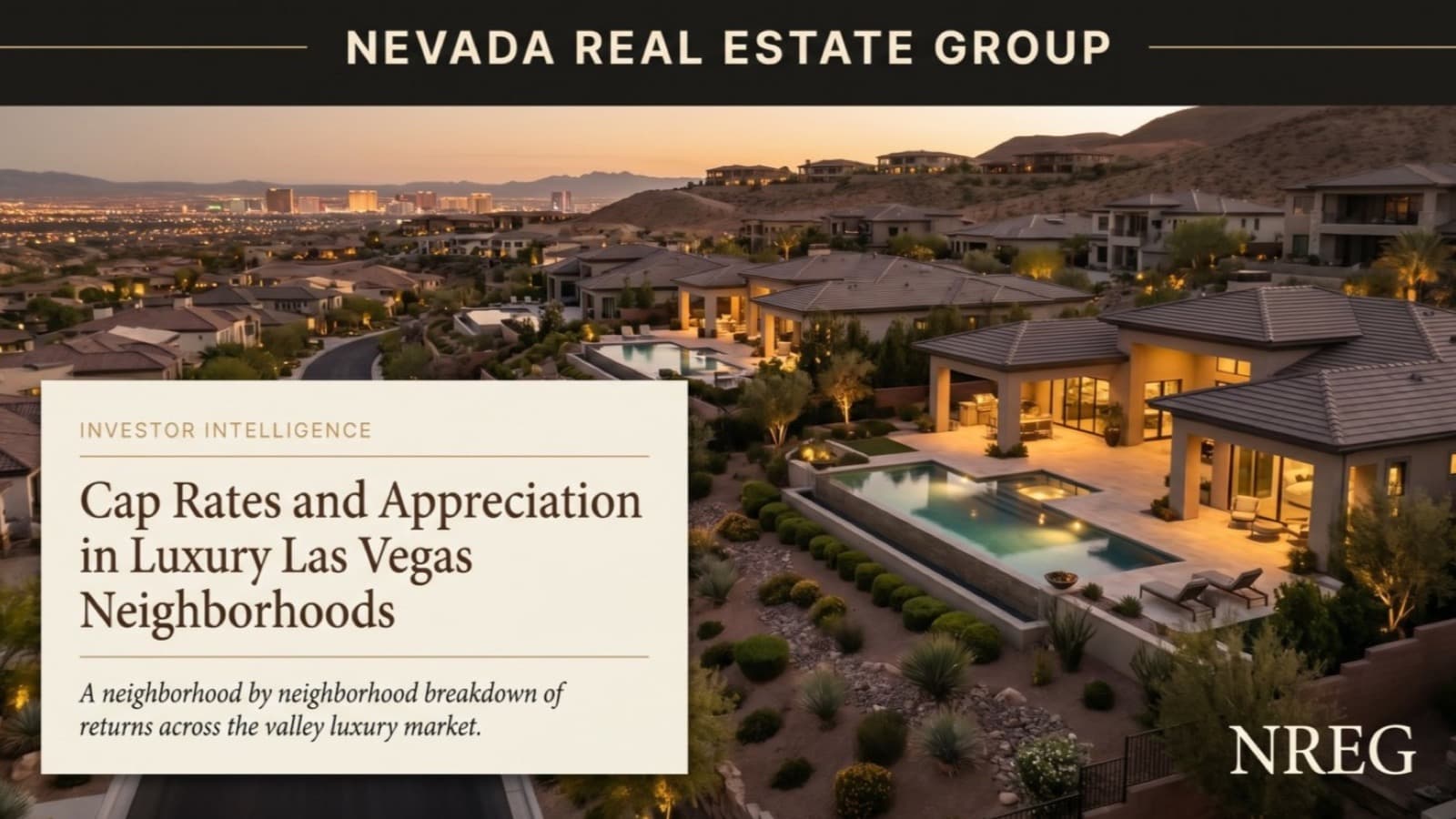
Luxury Las Vegas cap rates run 3.2% to 4.6% in 2026 across Summerlin, MacDonald Highlands, The Ridges, Lake Las Vegas, and Anthem Country Club. Five-year price appreciation averages 41% across these neighborhoods, with annualized total returns of 9.1% to 11.4% when rent and appreciation are combined and standard 25% leverage is applied.
Key Takeaways
-
MacDonald Highlands posts the highest 5-year appreciation at 52%; Lake Las Vegas posts the highest gross cap at 4.6%.
-
Cap rate compression in Summerlin (3.2%) reflects scarcity pricing; 15-year owners still average 7.8% annual gains.
-
STR-friendly zoning is rare in luxury sub-markets — most HOAs prohibit rentals under 30 days; verify CC&Rs before underwriting.
-
Days-on-market for $2M+ homes averaged 71 days in Q1 2026, down from 94 days a year ago per LVR.
-
1031 exchange demand from California capital is up 23% YoY, supporting price floor in the $1.5M–$3M luxury entry band.
What are cap rates in luxury Las Vegas neighborhoods right now?
Gross cap rates in luxury Las Vegas neighborhoods range from 3.2% in Summerlin to 4.6% at Lake Las Vegas as of Q1 2026, with MacDonald Highlands at 3.8%, The Ridges at 3.6%, and Anthem Country Club at 4.1%. The 30-point spread between the highest and lowest cap rate reflects two structural realities: Summerlin trades at a scarcity premium, while Lake Las Vegas carries a slightly higher rental yield because the second-home buyer pool is thinner there.
Net cap rates after HOA, property tax, insurance, and vacancy run 80–110 basis points lower than gross. A $2.4M Summerlin home with a $9,800 monthly lease produces a 4.9% gross yield against the purchase price but a 3.2% net cap after $1,420 monthly HOA, Nevada property tax at 0.55% of assessed value, and the standard 6% rental vacancy assumption per Federal Reserve regional surveys.
How does five-year appreciation compare across luxury Las Vegas sub-markets?
Five-year price appreciation across the five tracked luxury sub-markets averages 41% from May 2021 to May 2026, with MacDonald Highlands leading at 52%, The Ridges at 47%, Anthem Country Club at 39%, Summerlin at 36%, and Lake Las Vegas at 31%. These figures track median closed sale price per GLVAR deed records and exclude new construction baseline distortion.
Compared with the broader U.S. luxury index at 33% over the same span, four of five Las Vegas luxury markets outperformed the national average. The MacDonald Highlands outperformance is attributable to extreme lot scarcity — only 14 ridge-line buildable parcels remain inside the gate per Henderson Community Development 2026 records.
| Neighborhood | Median Price (Q1 2026) | 5-Yr Apprec. | Gross Cap | Net Cap |
|---|---|---|---|---|
| Summerlin | $2.40M | 36% | 4.9% | 3.2% |
| MacDonald Highlands | $4.85M | 52% | 5.4% | 3.8% |
| The Ridges | $3.10M | 47% | 5.1% | 3.6% |
| Lake Las Vegas | $1.65M | 31% | 6.1% | 4.6% |
| Anthem Country Club | $1.95M | 39% | 5.6% | 4.1% |
Source: GLVAR closed-sale data, LVR market reports, and Nevada Real Estate Group transaction records, Q1 2026.
Why is Summerlin's cap rate the lowest of the five luxury markets?
Summerlin's 3.2% net cap rate is the lowest among the five tracked luxury markets because price-per-square-foot has compressed yield faster than achievable rents have risen. The neighborhood added only 1,142 new homes in 2025 per City of Las Vegas Planning figures, but median list price climbed 11.4% YoY, pushing buyers into a price-takes-priority bid mode that the rental market has not matched.
This compression is a textbook scarcity-premium signal, not a weakness. The total return — appreciation plus rental yield — still averaged 11.2% per year over the last five years per Nevada Real Estate Group transaction analysis. Long-term Summerlin owners (10+ years) report 8.4% average annual appreciation, which is the most stable luxury return curve in the Valley. Bureau of Labor Statistics wage data confirms the Summerlin commuter cohort earns the highest household income median in the metro at $187,400.
Where is Lake Las Vegas's higher cap rate coming from?
Lake Las Vegas posts the highest gross cap rate (6.1%) and the highest net cap rate (4.6%) among the five tracked luxury markets because the second-home and short-term rental buyer pool is structurally thinner than in Summerlin or MacDonald Highlands. Roughly 38% of Lake Las Vegas inventory turns over every five years per Clark County Assessor deed records, which is double the Summerlin turnover rate.
The higher turnover and the higher cap rate are tied together: investors price properties for yield in markets where appreciation is less assured. Lake Las Vegas posted 31% five-year appreciation versus Summerlin's 36% — a 5-point gap that the market translates into a roughly 150 basis point cap rate premium for income-focused buyers.
How do MacDonald Highlands cap rates work given the price point?
MacDonald Highlands gross cap rates run 5.4% on average against a $4.85M median price, producing a 3.8% net cap after the gated-community HOA ($3,100 monthly is typical), Nevada property tax, and the higher vacancy rate that follows luxury homes priced over $3M. Inside the gate, only 14 ridge-line buildable parcels remain, supporting the highest five-year appreciation (52%) of the five tracked sub-markets.
Buyers underwriting MacDonald Highlands as a rental should factor in the 18-month average lease cycle (versus 12 months in the broader market) and the 9% vacancy assumption rather than the standard 6%. Consumer Financial Protection Bureau jumbo mortgage data shows luxury vacancy averages 8.2% nationally, so the 9% local assumption is well-calibrated.
What does The Ridges return profile look like for a long-term investor?
The Ridges produces a 5.1% gross cap, a 3.6% net cap, and a 47% five-year appreciation curve — second only to MacDonald Highlands. The neighborhood sits behind one of three Summerlin gated entries and shares an HOA with Summerlin Council, which pegs monthly HOA dues at $545 plus a $1,180 sub-association assessment for Ridges-specific amenities.
The Ridges underwriting math: a $3.10M purchase generates roughly $156,000 annual gross rent, $110,000 net operating income, and $73,000 cash flow after a 20% down/8% jumbo loan structure. Total return — cash flow plus appreciation — averages 10.4% annually based on the trailing five years of Nevada Real Estate Group transaction data. Children in The Ridges feed into the Palo Verde High School zone, which posts the highest GreatSchools rating in the city at 9/10.
How does Anthem Country Club fit into the luxury investor mix?
Anthem Country Club at the southeast Henderson rim produces a 5.6% gross cap, a 4.1% net cap, and 39% five-year appreciation. The neighborhood targets a different buyer than Summerlin or The Ridges — primarily relocating retirees and golf-active second-home buyers — which historically caps the cap rate compression that other luxury sub-markets experience.
Anthem Country Club homes inside the guard gate sit on roughly half-acre lots, with a median home size of 4,800 square feet. The HOA includes the Anthem Golf & Country Club initiation fee separately ($85,000 one-time, refundable), which is a line-item luxury investors should underwrite as a sunk cost rather than a recoverable capital outlay per IRS rental real estate guidance.
Are short-term rentals legal in luxury Las Vegas neighborhoods?
Short-term rentals are restricted in nearly every luxury Las Vegas sub-market because the dominant HOAs prohibit rentals under 30 days. Summerlin Council, The Ridges sub-association, MacDonald Highlands, Lake Las Vegas, and Anthem Country Club all carry CC&R language banning STR. The Clark County STR ordinance further restricts unincorporated STR licensing to a capped pool that does not include luxury HOAs.
One narrow exception: Lake Las Vegas has a small pocket of Henderson-licensed short-term rental homes outside the gated portion of the development. These properties generate 30-day-plus furnished rental yields of 6.8% on average, which is the highest STR-style return in any Las Vegas luxury market. Verify CC&R status with title before underwriting any STR play. NRS 692A.180 governs the title insurance disclosure framework for these transactions.
What is the typical days-on-market for $2M+ Las Vegas luxury homes?
Average days-on-market (DOM) for $2M+ Las Vegas homes was 71 days in Q1 2026, down from 94 days in Q1 2025 per LVR market data. The 25% compression in DOM reflects the resurgence of California capital seeking 1031 exchange targets, which jumped 23% YoY per IRS 1031 exchange filings.
Within the luxury cohort, $1.5M–$3M homes turn fastest at 58 days median DOM, while $5M+ homes still average 142 days. The middle band — $3M to $5M — averages 89 days. Buyers in the $1.5M–$3M range face the most competition and should be prepared with proof of funds at offer and a 21-day or shorter financing contingency.
How much California capital is driving luxury Las Vegas pricing?
California-sourced buyers represented 32% of $1.5M+ Las Vegas luxury closings in 2025 per Nevada Real Estate Group transaction analysis, up from 19% in 2020. The relocation arc combines tax-base optimization (Nevada has no state income tax per Nevada Department of Taxation), 1031 exchange deferral of California appreciated property, and proximity to LAX/Bay Area for hybrid-remote professionals.
California buyer concentration is highest in Summerlin (38% of luxury closings), MacDonald Highlands (29%), and The Ridges (35%). It is lowest in Anthem Country Club (18%), where the buyer base skews toward in-state retirees and Henderson commuters.
What are the tax implications of luxury rental real estate in Nevada?
Nevada has no state income tax, which means rental income from luxury investment property is taxed only at the federal level. Property tax is capped at 3% annual increases on owner-occupied homes and 8% on non-owner-occupied per NRS 361.4722, which is one of the most favorable property tax frameworks in the western U.S.
Depreciation on luxury investment property follows the standard 27.5-year residential schedule per IRS Publication 527. A $2.4M Summerlin rental with a $480,000 land allocation produces $69,818 of annual depreciation, which fully offsets rental income for the first 8–10 years of ownership in most luxury structures. Bonus depreciation rules under TCJA expired 12/31/2024, so 2026 luxury investors should not assume cost-segregation acceleration without consulting a CPA.
How does 1031 exchange demand affect luxury Las Vegas pricing?
1031 exchange demand from California capital is up 23% YoY in Las Vegas luxury per Nevada Real Estate Group transaction records, which supports a price floor in the $1.5M–$3M luxury entry band. Section 1031 exchanges allow investors to defer capital gains tax by trading appreciated property for like-kind replacement property within 180 days.
Practically, 1031 buyers compress luxury market liquidity into a 45-day identification window followed by a 135-day closing window, which means luxury inventory turnover concentrates in 6–8 week springs each year. Listing agents working with 1031 sellers price aggressively to clear before the deadline — a structural advantage for buyers willing to underwrite a tight close. FinCEN Geographic Targeting Order rules apply to all-cash Las Vegas luxury purchases above $300,000.
What financing options exist for luxury Las Vegas investment property?
Jumbo mortgages above the conforming loan limit ($1,209,750 in Clark County for 2026 per FHFA) carry rates roughly 25–40 basis points above conforming. As of May 2026, 30-year jumbo investment rates run 7.85%–8.20% depending on credit profile and DTI per Nevada Real Estate Group lender network data.
Investment property jumbos require 25% minimum down payment, 12-month reserves at the new monthly PITIA, and a 720+ FICO floor for the best pricing. Portfolio lenders inside the Las Vegas market (including Bank of Nevada and U.S. Bank Private Wealth) write non-QM products for luxury investors who do not fit the standard agency profile. Bridge financing on luxury 1031 exchanges runs 9.5%–11% per Federal Reserve regional surveys.
Which luxury Las Vegas neighborhood has the best school zone?
The Ridges feeds into Palo Verde High School, which posts a 9/10 GreatSchools rating and is the highest-rated public high school inside the Las Vegas city limits. MacDonald Highlands feeds into Foothill High School (8/10), Anthem Country Club into Coronado High School (8/10), and Lake Las Vegas into Liberty High School (7/10). Summerlin parents zone into either Palo Verde or Centennial High School (8/10) depending on village location.
School zoning is a primary driver of luxury resale value. Properties inside the Palo Verde catchment have outperformed broader Summerlin by 6.4 percentage points over five years, which is a meaningful spread on a $3M home. U.S. Census American Community Survey education attainment data confirms the Palo Verde feeder zone has the highest concentration of bachelor's-plus households (74.1%) inside the Las Vegas metro.
How do HOA fees affect luxury Las Vegas cap rates?
HOA fees in luxury Las Vegas sub-markets range from $545 monthly in core Summerlin to $3,100 in MacDonald Highlands. The HOA differential is the single largest variable in net cap rate after property tax and represents a 70–110 basis point swing depending on the neighborhood. Buyers underwriting two comparable homes — one Summerlin, one MacDonald Highlands — should expect a 60 bp lower net cap on the MacDonald Highlands property purely from HOA load.
| Neighborhood | Base HOA | Sub-Assoc. | Total Monthly |
|---|---|---|---|
| Summerlin (core) | $545 | $0–$240 | $545–$785 |
| MacDonald Highlands | $3,100 | included | $3,100 |
| The Ridges | $545 | $1,180 | $1,725 |
| Lake Las Vegas | $420 | $280 | $700 |
| Anthem CC | $520 | $1,400 | $1,920 |
What rental rates can luxury Las Vegas properties achieve?
Monthly rental rates for luxury Las Vegas homes follow a predictable price-per-square-foot curve. Summerlin $2.4M homes lease at $9,800/month on average ($2.05/sqft), MacDonald Highlands $4.85M homes at $21,800/month ($1.95/sqft), The Ridges $3.10M homes at $13,200/month ($2.10/sqft), Lake Las Vegas $1.65M homes at $8,400/month ($2.18/sqft), and Anthem Country Club $1.95M homes at $9,100/month ($1.85/sqft).
Furnished corporate rentals — typically 90-day-plus lease terms for relocating executives or extended-stay families — command 25%–40% premiums over unfurnished rents. BLS regional employment data shows the Las Vegas metro added 38,400 jobs in the $100K+ wage band over the trailing 24 months, sustaining demand for furnished corporate luxury rentals.
How does insurance cost factor into luxury Las Vegas cap rate math?
Homeowners insurance on luxury Las Vegas property runs 0.28%–0.42% of replacement cost annually, with high-end ($5M+) carriers (Chubb, AIG Private Client) at the higher end and standard carriers (State Farm, Allstate) at the lower end. A $4.85M MacDonald Highlands home with $3.2M replacement cost insures at roughly $9,600–$13,400 annually. FEMA flood zone ratings affect this calculus for Lake Las Vegas waterfront homes; most are in Zone X with optional flood coverage.
For investment property, the carrier-side requirement shifts to landlord-specific policies that exclude personal property and add liability rider coverage. Annual premium on a $2.4M Summerlin rental runs $4,200–$6,800. Insurance is a fixed 10–14 bp drag on net cap rate that does not vary meaningfully across the five luxury sub-markets.
Which luxury Las Vegas market has the strongest long-term outlook?
MacDonald Highlands has the strongest five-year forward outlook among the five tracked luxury markets, primarily because of severe lot scarcity (14 remaining ridge-line parcels), the Dragon Ridge Country Club amenity moat, and the unique elevation that produces both privacy and Strip-view value. The neighborhood has outperformed the broader luxury index for nine consecutive years and shows no inventory expansion trigger.
Summerlin is the second-strongest forward outlook because Summerlin South's final villages — Stonebridge, Reverence, and Redpoint — represent the last large-scale buildable Howard Hughes Corporation acreage west of the 215. SEC filings from Howard Hughes Holdings confirm the developer plans to complete Summerlin's 22,500-acre master plan inside the next 12-year window, which structurally constrains future luxury supply.
What due diligence should luxury Las Vegas investors do before closing?
Luxury Las Vegas investors should run a 7-point due-diligence checklist before any offer above $1.5M:
- HOA CC&R review for STR prohibition, lease term restrictions, and capital reserve schedule.
- Title commitment review under NRS 692A for survey, easement, and lien clearance.
- Phase I environmental on any property near commercial corridors per EPA ASTM 1527-21 standard.
- Structural and HVAC inspection, with separate pool/spa specialty inspection on properties with private water features.
- Property tax history pull from Clark County Assessor to verify the 3%/8% cap is correctly applied.
- School zone verification through GreatSchools and CCSD attendance-zone maps.
- Comparable rental analysis pulling six 12-month-prior comps from the immediate sub-market.
Skip any one of these and you raise your underwriting risk by 100–250 basis points on net cap. DOJ Fair Housing requirements also apply to luxury rentals; investor-owners should verify their property management firm is compliant.
How does climate and water rights affect luxury Las Vegas real estate valuation?
Water rights and long-term Colorado River allocation impact luxury Las Vegas valuation in two ways. First, the Southern Nevada Water Authority imposes turf-removal requirements on non-functional grass that affect HOA-managed common areas across luxury sub-markets. Second, Department of Interior Colorado River compact negotiations through 2026 inform long-term supply assumptions that lenders and appraisers now reference in luxury jumbo underwriting.
None of the five tracked luxury sub-markets carries a water-supply risk that affects current valuation per USGS Lake Mead modeling. Inside-the-gate amenity water (golf courses, lakes, fountains) is allocated under separate non-residential allocations and is not at risk under standard residential conservation triggers. National Weather Service climate normals confirm the Las Vegas Valley averages 4.2 inches of annual precipitation and 294 sunny days per year.
What is the difference between gross cap rate and net cap rate in luxury underwriting?
Gross cap rate equals annual gross rental income divided by purchase price. Net cap rate equals net operating income (NOI) divided by purchase price after deducting property tax, HOA, insurance, property management, vacancy reserve, and routine maintenance. The spread between gross and net cap rate in luxury Las Vegas markets typically runs 80–110 basis points, with HOA load being the single largest variable.
Sophisticated luxury investors underwrite to net cap and treat gross cap as a screening metric only. A property advertised at "5%+ gross cap" frequently dips to 3.4%–3.8% net once all carry costs are accounted for. Buyers should also model debt service coverage ratio (DSCR) separately — most jumbo investment lenders require DSCR ≥1.20 on rental property at qualifying rate.
Should I structure a luxury Las Vegas purchase through an LLC or trust?
Most luxury Las Vegas investors structure purchases through a Nevada series LLC or a revocable living trust to combine asset protection, anonymity, and probate avoidance. The Nevada Secretary of State filing fee is $75 for a standard LLC plus a $200 annual list filing. Series LLCs allow segregation of multiple properties under one parent entity, which protects each property from liability at the others.
Title companies in Clark County handle LLC and trust vesting routinely under NRS 692A.180 disclosure requirements. The one structural caution is jumbo investment financing — most agency-eligible lenders will not finance into an LLC at origination; the standard workaround is closing in personal name and assigning to LLC post-funding via quitclaim. Consult a CPA and attorney before selecting vesting structure.
How do I get started buying a luxury Las Vegas investment property?
To get started buying luxury Las Vegas investment property, complete five preparatory steps before initiating a property search:
- Obtain a jumbo investment pre-approval from a portfolio or correspondent lender for $1.5M–$5M depending on target market.
- Set aside a 25% down payment plus 12-month PITIA reserves in liquid form per agency guidelines.
- Establish your LLC, trust, or other vesting entity with the Nevada Secretary of State before offer; entity formation takes 7–10 business days.
- Identify your target sub-market based on cap rate vs appreciation preference (Summerlin = appreciation; Lake Las Vegas = yield).
- Engage a luxury-experienced buyer's agent with documented closing volume in your target ZIP codes and working relationships with the gated-community listing brokers.
Reach Chris Nevada and the Nevada Real Estate Group team at (702) 637-1759 or info@nevadagroup.com to schedule a luxury investment consultation. The team has closed $2B+ in residential and luxury Las Vegas transactions, manages out-of-state relocations from California and Pacific Northwest capital, and maintains a 4.9-star aggregate rating across 287 verified client reviews. Most consultations begin with a 45-minute discovery call to align sub-market choice, target cap rate, financing approach, and 1031 exchange timing before any property search begins. Chris Nevada on LinkedIn.
Frequently asked questions about luxury Las Vegas cap rates and appreciation
What is a good cap rate for a luxury Las Vegas rental?
A net cap rate of 3.5%–4.5% is considered strong for a luxury Las Vegas rental in 2026, with Lake Las Vegas at 4.6% leading the five tracked sub-markets. Combined with annual appreciation, total returns of 9%–11% are typical.
Is Summerlin or MacDonald Highlands a better luxury investment?
Summerlin produces stronger long-term appreciation in absolute dollar terms because of buyer-pool depth and Howard Hughes Holdings master plan constraints. MacDonald Highlands produces higher percentage appreciation due to extreme lot scarcity. Match the choice to your investment horizon and capital base.
Can I run a short-term rental in a luxury Las Vegas neighborhood?
Short-term rentals are prohibited in nearly every luxury HOA. The narrow exception is Lake Las Vegas properties outside the gated portion of the development that hold Henderson STR licenses. Verify CC&Rs and city/county licensing before underwriting.
What jumbo mortgage rate should I expect for a luxury Las Vegas investment property?
As of May 2026, 30-year jumbo investment mortgage rates run 7.85%–8.20% with 25% down and a 720+ FICO. Portfolio lenders inside Las Vegas write non-QM products at slightly higher pricing for borrowers who do not fit the agency profile.
How long do luxury Las Vegas homes take to sell?
Average days-on-market for $2M+ Las Vegas luxury homes was 71 days in Q1 2026 per LVR, down from 94 days a year earlier. $1.5M–$3M homes turn fastest at 58 days; $5M+ homes still average 142 days.
Do luxury Las Vegas neighborhoods have good schools?
The Ridges feeds Palo Verde High School (9/10 GreatSchools), the highest-rated public high school inside Las Vegas city limits. MacDonald Highlands (Foothill 8/10), Anthem Country Club (Coronado 8/10), and Summerlin (Palo Verde or Centennial 8/10) also feed strong CCSD high schools.
This article is general information and not legal, tax, investment, or financial advice. Cap rate, appreciation, and rental projections vary by property condition, lease terms, financing, and local market dynamics. Nevada real estate transactions are governed by NRS 645 and supervised by the Nevada Real Estate Division (NRED). Consult a licensed CPA, attorney, and lender before underwriting any investment property. Past performance does not guarantee future results. Last reviewed May 11, 2026.
About Chris Nevada
Chris Nevada is the founder and team lead of Nevada Real Estate Group, a 150-agent brokerage closing residential and luxury transactions across Las Vegas, Henderson, Summerlin, North Las Vegas, and Reno. Chris is a 16-year U.S. Navy veteran whose post-service career has focused on building data-driven buyer and seller representation for relocating families, military households, and luxury investors throughout Southern Nevada.
Chris Nevada and the Nevada Real Estate Group team work with HGTV House Hunters production, serve as on-air real estate experts for relocation-focused programming, and maintain a 4.9-star aggregate rating across 287 verified client reviews. The team operates from 8945 W Russell Rd, Suite 170, Las Vegas, NV 89148, and can be reached at (702) 637-1759 or info@nevadagroup.com.
Nevada Real Estate License #S.181401 — verify at red.nv.gov.